Clyfford Still Museum
Website usability testing for the Clyfford Still Museum
This post is based on a report produced for Spellerberg Associates by Amanda Moon and Marian Oman. Their research was conducted at the School of Information at the University of Texas at Austin as part of a usability course taught by Randolph Bias.
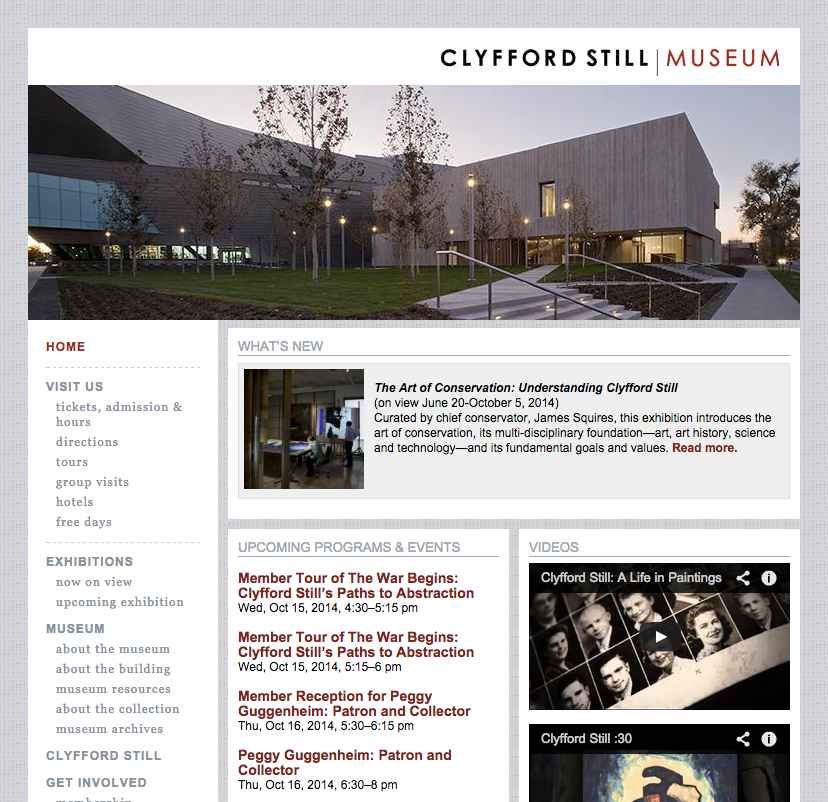
The Clyfford Still Museum in Denver, Colorado is a single-artist museum dedicated to the American master abstract expressionist painter. The Museum’s collection contains nearly 95 percent of the artist’s total output—more than 3,200 artworks—and houses the complete Still archives of sketchbooks, journals, and notebooks.
At the beginning of a website redesign project, we undertook a usability evaluation of the Museum’s website. Designing this evaluation to assist in identifying key areas of focus, our primary objectives were to:
- Better understand the mental models and expectations of website’s users;
- Identify the most salient usability shortcomings of the current site design;
- Offer recommendations for improving the overall user experience;
- Create a benchmark for any future usability testing.
We identified key use cases and goals by consulting with Museum stakeholders and conducting a heuristic site audit.
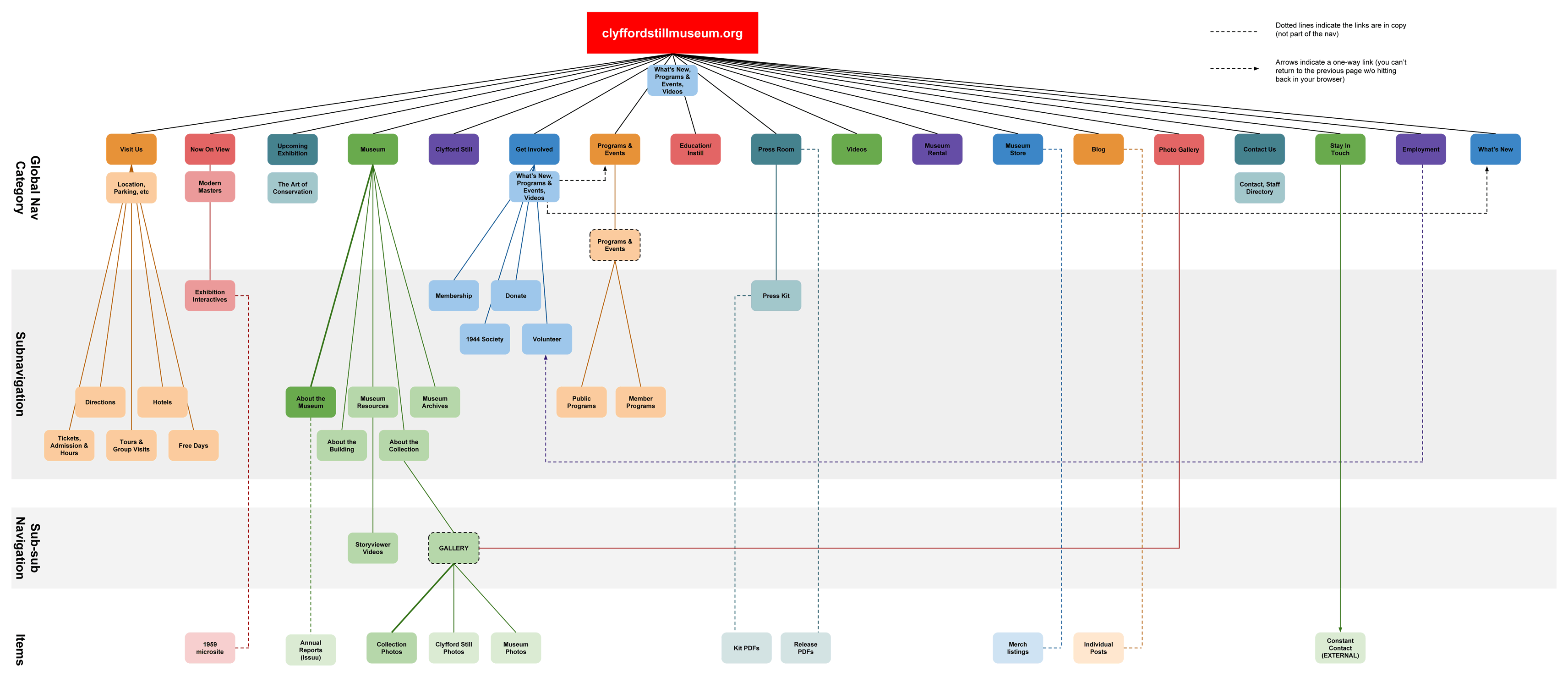
We then designed and conducted two evaluation activities:
- A card sort protocol generated insight into visitors’ mental models of site content and identified ways to improve the website’s information architecture and navigation;
- Three persona-based test scripts identified the most salient usability challenges presented to website visitors.
Twelve individuals participated in the evaluation, which was conducted at the University of Texas at Austin.
Card Sort
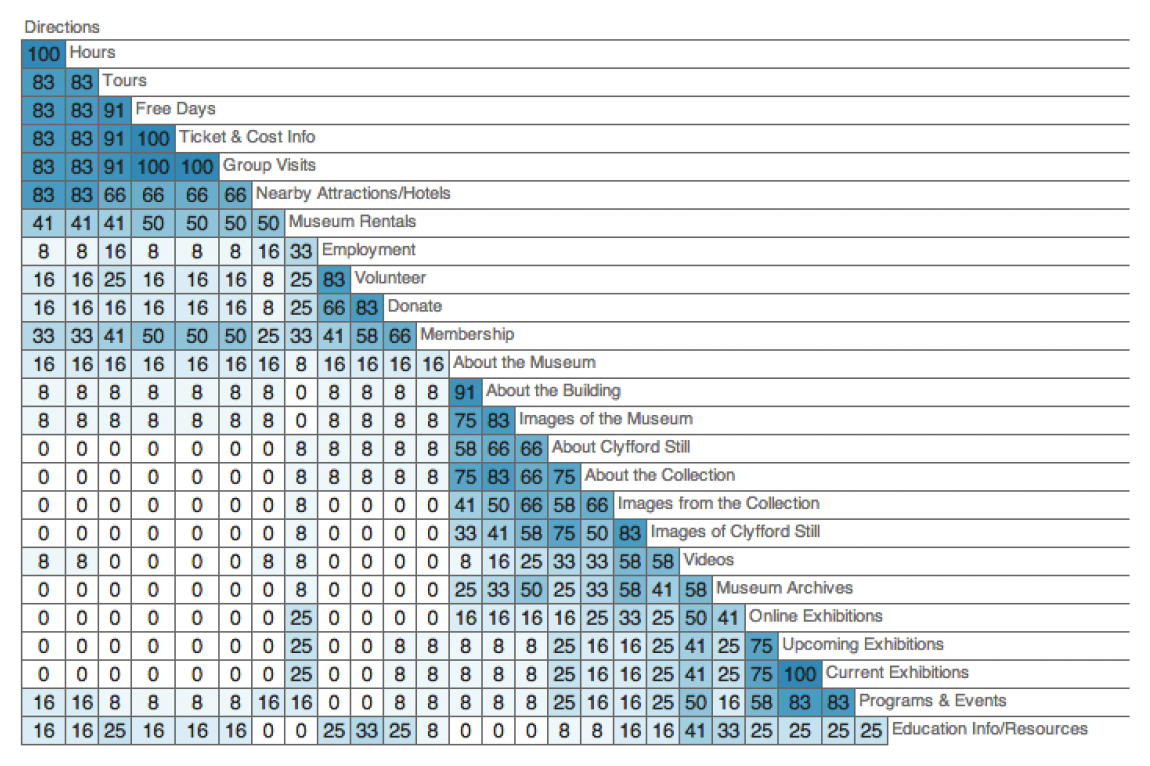
We narrowed 40 words from the existing website navigation down to 26 words that best represented the content. Each user then sorted these words into named categories using language of his or her own devising. They were encouraged to define no fewer than three and no more than five categories.
This activity was conducted using the the browser-based software program Optimal Sort, the results from which were used to generate a similarity matrix showing the percentage of participants who agree with each card pairing.
Task-based Test Session
User personas function as lenses through which to evaluate the site; each persona represents a distinct segment of the target audience and provides a framework for understanding that user segment’s typical goals and tasks.
We tested a broad swath of the site by testing three different user persona “paths,” which allowed us to test more tasks across all session types than would be reasonable to include in a single user’s test session. The three user personas we developed for this evaluation were:
The Art Enthusiast
You’re an art enthusiast living in Denver. Even though the Clyfford Still Museum has been open for a few years, you’ve never visited. You decide you’d like to check it out this Saturday. You will take your 7-year-old daughter and you will buy tickets online.
The Researcher
You’re a graduate student in Art History. You’re writing your thesis on some of Clyfford Still’s contemporaries, and you think some of their letters to Still may be housed in the Clyfford Still Museum’s archive.
The Educator
You’re a 5th grade teacher in Denver. You want to bring your class to visit the Clyfford Still Museum. Ideally, you’d like to schedule the field trip for a Tuesday morning next month.
Participants were assigned for their relative similarity to the user personas. For instance, the participants who completed “the educator” tasks were actually teachers.
We read each participant the persona-based scenario to which they had been assigned, then directed them to the website. They were asked to complete the tasks while “thinking aloud,” which provided insight into their thought processes as they moved through the website.
After the tasks were completed, the moderator asked several open-ended questions to identify any additional user needs or expectations that were not met by the website.
From Research to Redesign
This research revealed that improving the site’s navigation structure and consistency, creating more connections between pages, and increasing the image-to-text ratio throughout the site would be essential in the creation of a more user-friendly experience for Museum visitors.
This study provided was followed by additional phases of evaluation, including with Museum stakeholders, which tested the assumptions we’d made and the conclusions we’d arrived at. The entire process informed a website redesign, which launched in October 2014.
Website redesign for the Clyfford Still Museum

Featuring a bold, responsive design, the new website for the Clyfford Still Museum launched in October, 2014. This new site helps the museum position itself as a destination, a site of pilgrimage for art lovers interested in the life and work of master abstract expressionist painter Clyfford Still.
The project goals were to simplify the navigation and information architecture; build a new, more flexible and user-friendly content management system; and provide a updated, responsive design that featured more generous visuals and highlighted the museum’s building—an architectural gem.
We employed an Agile approach and worked with museum stakeholders to identify institutional priorities for the redevelopment project. We conducted several assessments of the previous site, including a site audit and a usability study, as well as several assessments of the information architecture throughout the process, to test our assumptions and inform our final decisions.
Project Collaborators
Content Strategist and Project Manager: Sarah Wambold
Designer: Scott Reinhard
Developer: Marty Spellerberg / Spellerberg Associates
for the Clyfford Still Museum: Dean Sobel and John Eding
Digital Catalogue for the Clyfford Still Museum’s Works on Paper

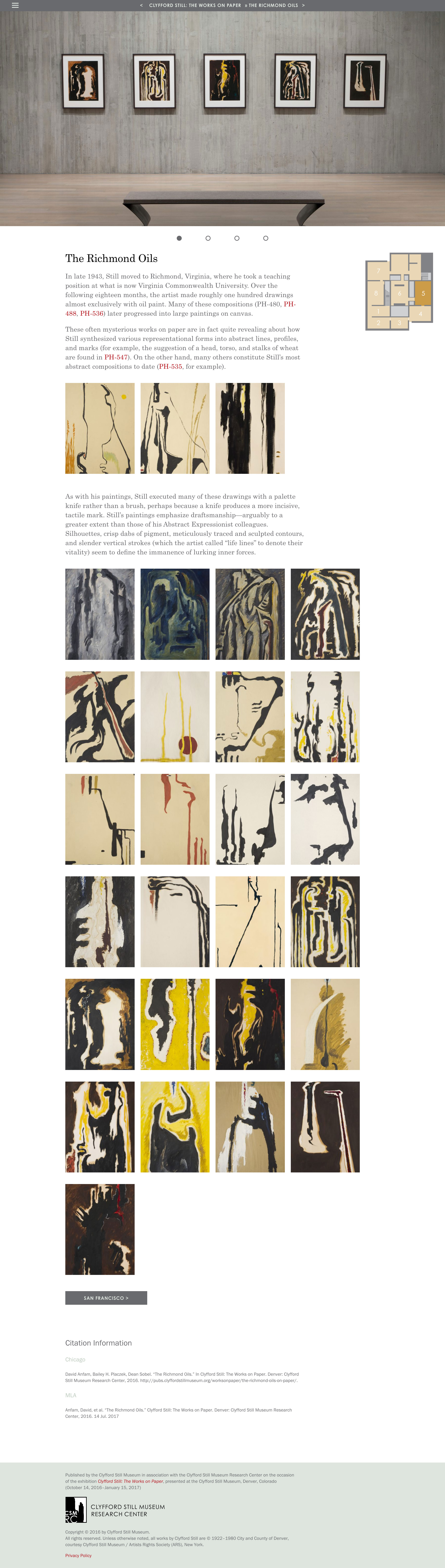
Clyfford Still: The Works on Paper is the first exhibition devoted exclusively to Still’s graphic art. The accompanying exhibition catalogue, the Clyfford Still Museum’s first in a digital format, provides a visually rich experience of never-before-seen works.
Distribution online has ensured a much larger audience for this work, a major priority for the museum, whose collection rarely travels outside Denver. Online user sessions for the publication have far exceeded our expectations in numbers and geographic reach, and quickly surpassed estimates for sold copies of a print run.
The online publication features installation photographs from every gallery wall in the exhibition, as well as high-resolution images of all 256 objects included in the exhibition. The deep-zoom interface allows for an intimate examination of these drawings, revealing evidence of Still’s hand and his mastery of drawing media.
The publication was created using a static-site-generator plugin (Simply Static) on a custom-built theme in WordPress. Inspired by recent work in digital publishing by the Getty Museum, the static-site approach helps ensure stability and longevity for the publication and its scholarly content. E-pub and PDF formats are also available via the online publication at no charge. A 152-page print-on-demand softcover catalogue is available through CSM’s online store.
This project was a collaboration with Sarah Wambold.
pubs.clyffordstillmuseum.org/worksonpaper
Web-based Touchscreen Video Kiosk Platform for the Clyfford Still Museum

Clyfford Still Museum’s new video kiosk platform was built to scale with the museum’s growing video library. The priorities for the system were to make the videos accessible to people with hearing impairments; to design a system that could be content managed from afar; and to create an architecture that could scale with the content—one that could easily accommodate as many videos as desirable, and allow for flexibility in the organization and presentation of those videos on a station-by-station, screen-by-screen basis.
It features touchscreen navigation; closed captioned videos; and the ability to create, publish, and maintain multiple custom interfaces simultaneously. Although the application was built for onsite audiences, the new system leverages web standards for accessibility and sustainability.
The technical configuration is a lightweight, easy-to-update system that fits well into CSM’s technology stack and can accommodate an infinite number of videos and combinations thereof. The interface’s content management is handled through WordPress. The application itself is written in React JS, and communicates with WordPress via a JSON feed. The videos and captions are hosted on Vimeo and accessed by the kiosk application through Vimeo’s API. Each station runs on a Mac Mini that is configured for touch inputs (which is not native in Mac OS). The application runs in Chrome through the Kiosk app extension for a frameless, secured experience.
“Emotion, Intimacy and Space: Designing and Developing the Clyfford Still Museum’s In-Gallery Video Kiosk System,” to be presented at the MCN Conference in November 2018, will discuss how digital design can reflect the physical space in which it is installed, how graphic and movement choices affect visitors’ sense of intimacy, and how the interactive components of museum visitors’ experience can be made approachable through the collaborating disciplines of design and development.
This project was a collaboration between Normal, Spellerberg Associates, Will Meier, and Zack Rothauser. The internal team for this project included Sarah Wambold, Victoria Eastburn and Dean Sobel.