MCA Chicago
Goshka Macuga microsites for the Museum of Contemporary Art Chicago
This post is a collaboration between Sarah Wambold and Marty Spellerberg. Sarah Wambold is a Denver-based project manager and documentary producer. Marty Spellerberg is an Austin-based interactive media designer/developer.
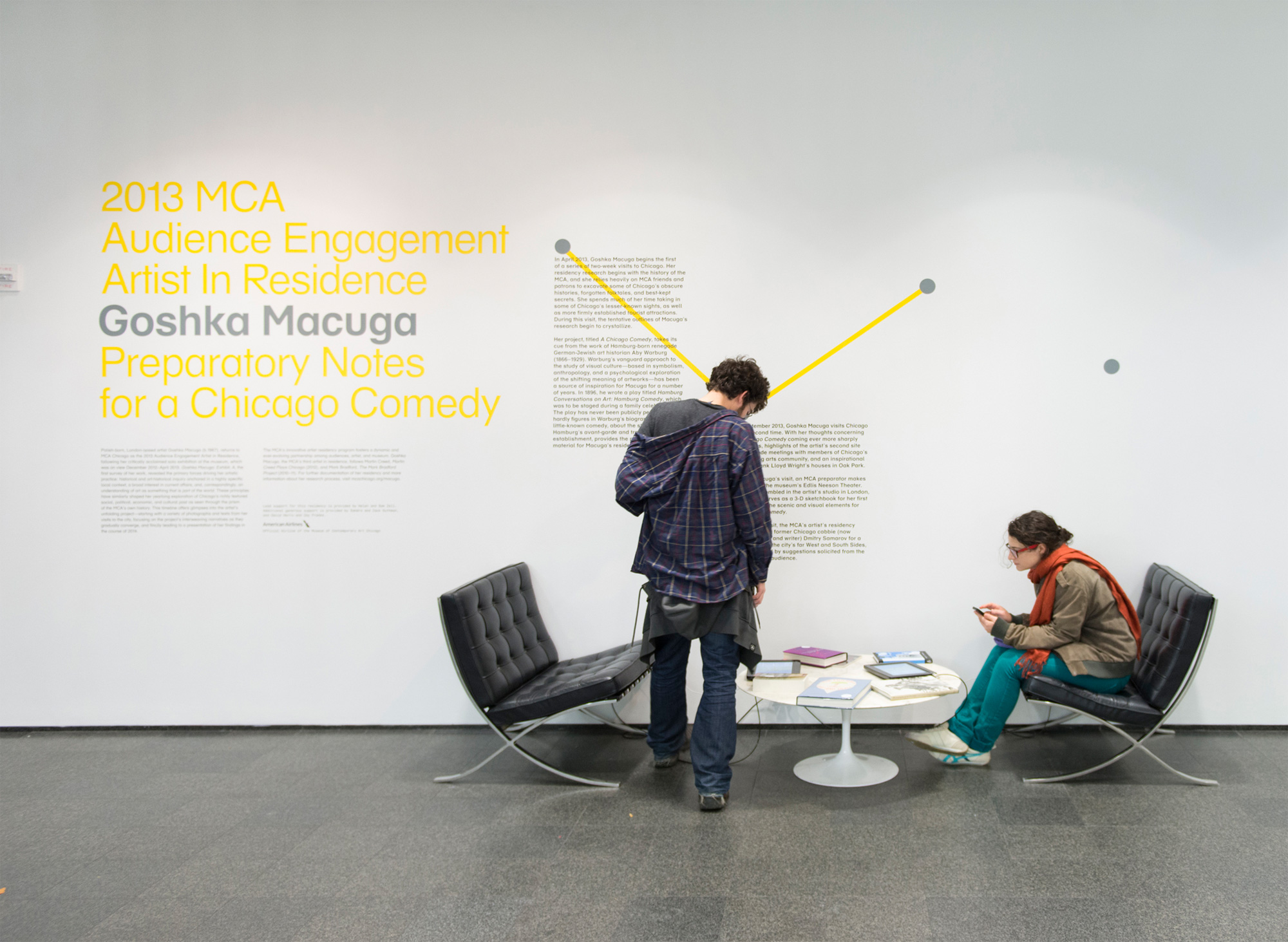
Goshka Macuga is the MCA Chicago’s 2013 Artist In Residence.
“Macuga’s work interweaves two strands that have helped define contemporary art in the last decade: artists’ increasing tendency toward historical and archival research and their growing interest in strategies of display and the dialogue between artistic and curatorial practice.”
— Dieter Roelstraete
Inspired by Hamburg Conversations on Art: Hamburg Comedy, a 1896 work German Jewish art historian Aby Warburg, Macuga’s residency project is to create a Chicago Comedy. But because the resulting work, likely to be a play, will not exist until the end of the term, the artist’s process is being documented and presented to the public as Preparatory Notes for a Chicago Comedy. Our team became involved as interactive media designers/developers.
With no artist on site—she’s in London—and no objects being produced in the early phases, how would museum visitors know there was, in fact, a residency taking place? We needed a physical manifestation or marker that would let the public know what was happening as it was happening.
In-Gallery iPad Kiosk
The artist was opposed to creating a object or an installation “as a placeholder,” so digital, with its ability to present a depth of information in a physically economical and engaging way, emerged as the best candidate. iPads as part of a title wall installation became the solution for a physical, onsite manifestation of the residency.
Early in the year, Macuga was joined by MCA Curator Dieter Roelstraete for a romp around the city, seeking to “excavate Chicago’s lesser-known histories, forgotten folktales, and best-kept secrets.” The material they generated became the basis for our presentation.
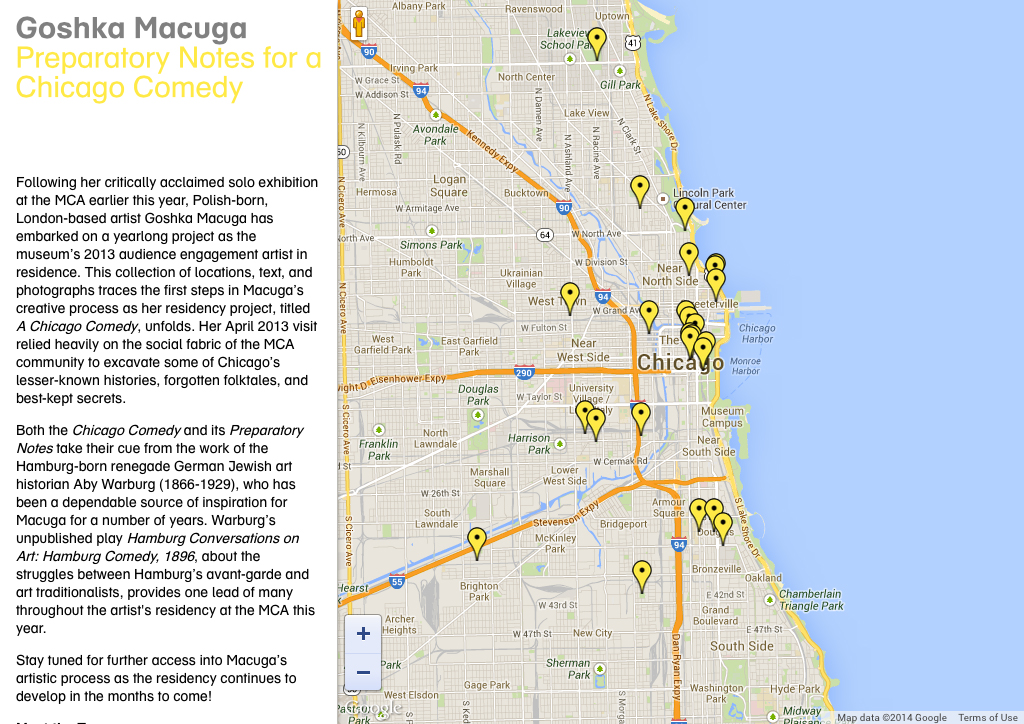
Since the artist’s notes were organized around places she visited around the city, we chose an interactive map interface. This provided an instantly relevant format: Onsite visitors are, by definition, present in Chicago and likely to relate to a map of the city. This also served to emphasize the project’s connection and relevance to the local community, a goal of the Museum’s residency program generally.
The technical solution was based on the technique demonstrated in Marty’s Integrating WordPress and Google Maps tutorial, which he previously used to create an in-gallery kiosk for the Chinese American Museum, Los Angeles.
Museum Website
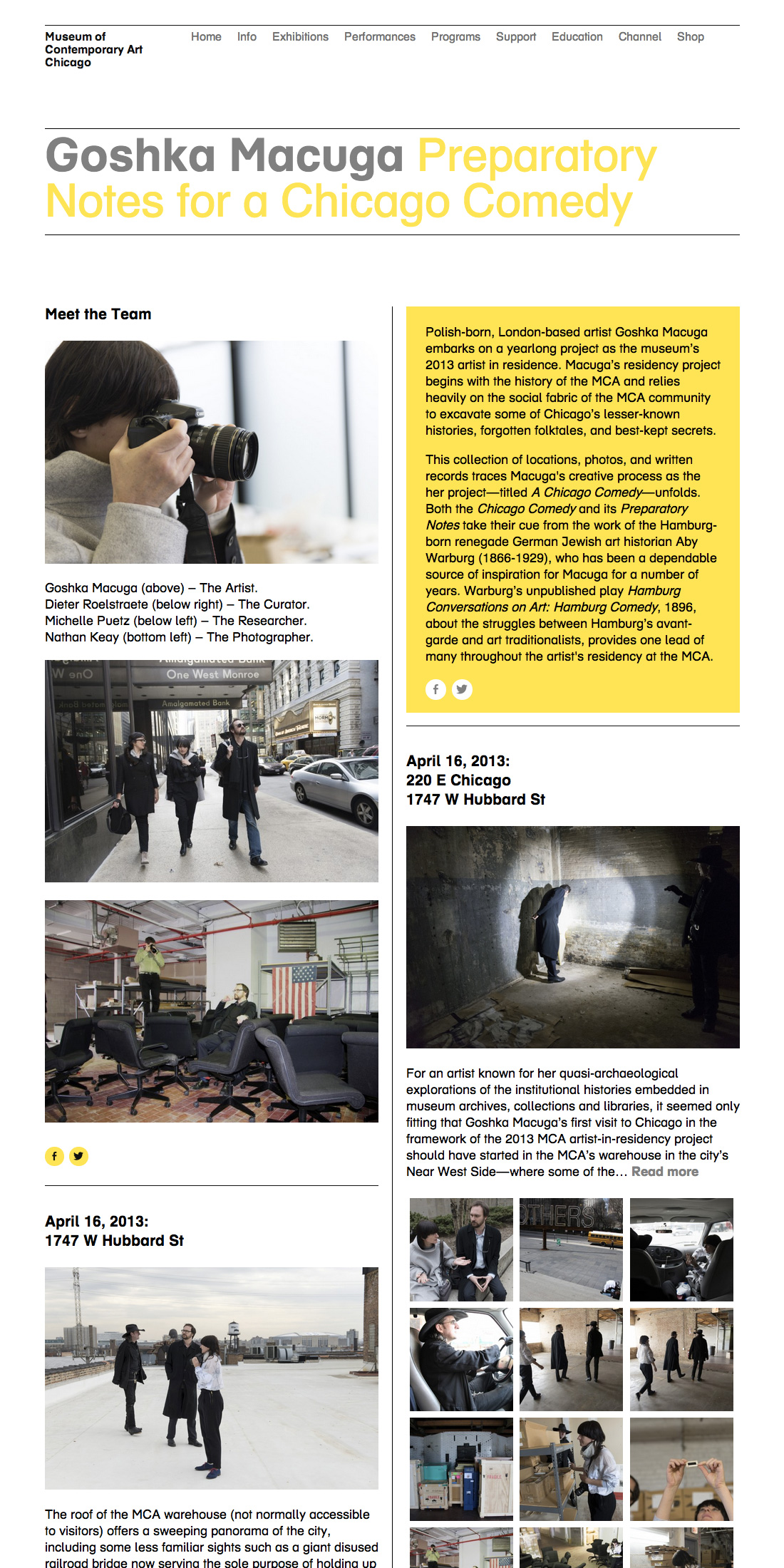
We also wanted to put something online that could live-on once the residency itself is completed. We realized, over several discussions with the curator, that Macuga’s work would find its form in phases: Lateral research of canvassing Chicago; vertical research of deep dives at the Warburg Institute; production, likely to happen abroad; and a to-be-determined final presentation. The digital strategy would need to respond to each of these.
We recognized that the map interface would be inadequate for telling the rest of the story of the residency; as Macuga moved from research-based activities, some happening abroad, and into production, using a map to navigate the content would no longer make sense.
The Museum had a history of stand-alone project blogs, and we made the choice to continue that format in this case. The first thing we did was to consolidate the most recent blogs under a unified banner and feed, which improved the prospects for long-term maintenance, as well as providing added context for future researchers. But we also wanted to provide a unique feel specific to the here-and-now, so we designed a two-column landing page using the Packery layout library.
The project was driven by a core creative concept that came into view over a period of time, as the artist’s process revealed the characteristics of the artwork she is creating. By adopting an agile design and development methodology, our team was able to respond to the changing needs for the project mid-course. The result was a compelling, revealing and engaging presentation for Museum visitors both onsite and online.
Project Collaborators
Digital Team
Producer and Project Manager: Sarah Wambold
Designer and Developer: Marty Spellerberg
Content Coordinator: Marian Oman
Residency Team
Project Manager: Erika Hanner
Curator: Dieter Roelstraete
Content Creators: Michelle Puetz, Dieter Roelstraete, and Goshka Macuga
Understanding Museum Website Visitor Motivation using Google Analytics
This post is a collaboration between Sarah Wambold and Marty Spellerberg. Sarah Wambold is a Denver-based project manager and documentary producer. Marty Spellerberg is an Austin-based interactive media developer.
Google Analytics is a powerful tool for understanding traffic to a website. The standard site statistics, however, don’t always tell the full story.
For instance, interpreting the duration of an average site visit is highly speculative. It is typically thought that the longer a visitor spends on the site the better, and that shorter interactions are less successful. But this is not necessarily the case.
Take a visitor who comes to the site looking for the museum’s hours. If she was able to quickly and efficiently locate the information she needed, this interaction should be considered positive, despite the short visit duration. Conversely, if she was unable to find the information and had to search for a longer amount of time to find the information, the long duration would signal that the interaction had been considerably less successful in this instance.
A combination of survey techniques is necessary to overcome this reporting challenge and understand the successes, shortcomings, and opportunities of a Museum’s website.
Augmenting the Standard Stats
Working with the Museum of Contemporary Art Chicago, we wanted to increase our insight into how the site was being used. We knew that, in order to analyze current and inform future online offerings, we needed to be able to identify which kinds of users were accessing the site. Are there, in fact, different motivations for visitors to come to the MCA’s site? If so, how do those groups differ in their use of the site? To gain this information, we conducted a Visitor Motivation Survey.
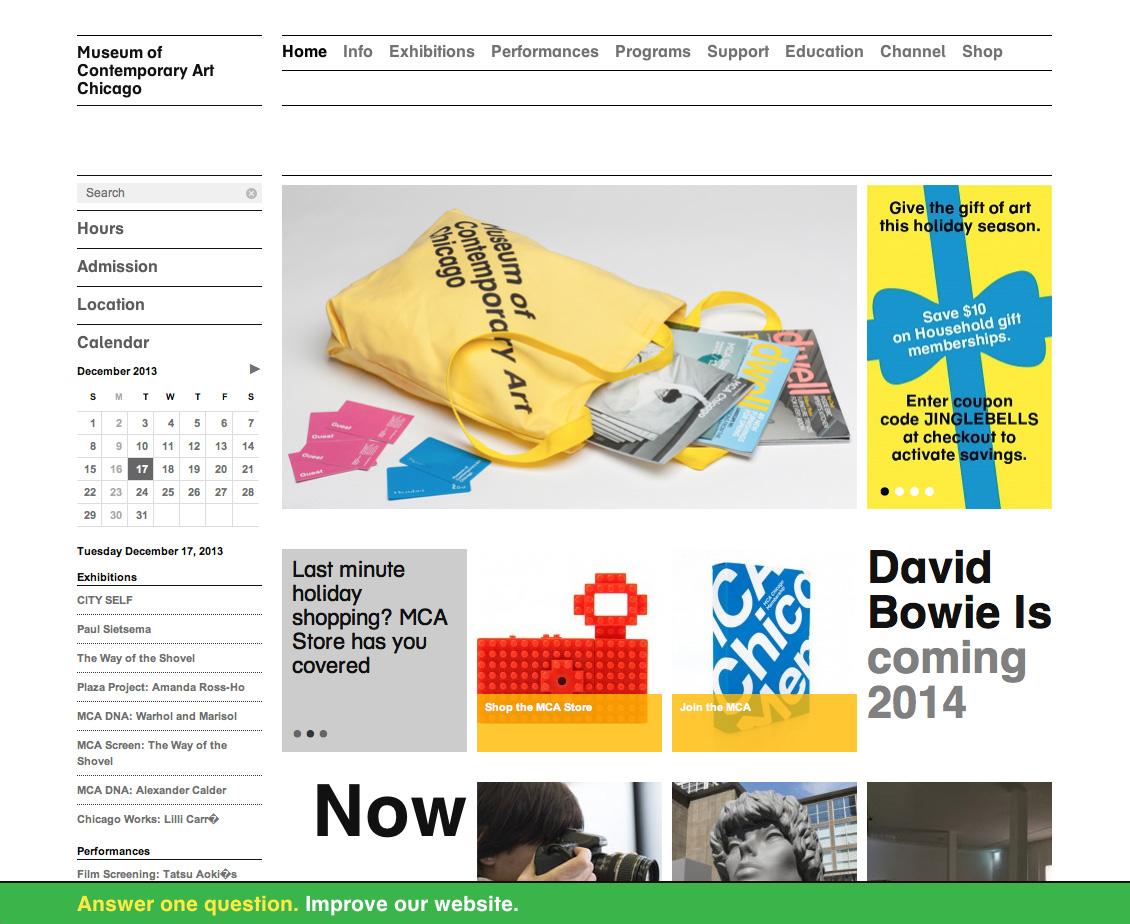
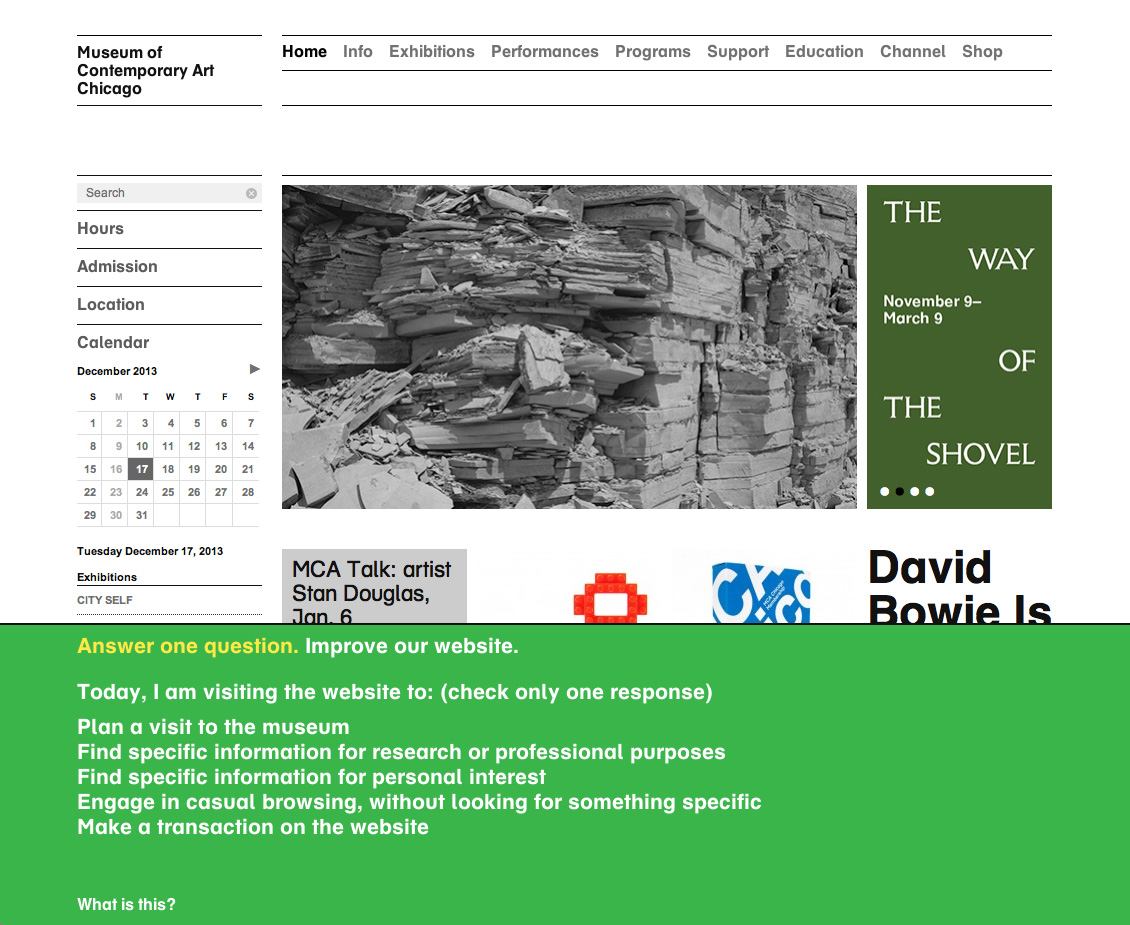
We modeled our survey after a study by the Indianapolis Museum of Art. We placed a one-question survey on the homepage, asking visitors to the site to self-identify into one of five user groups based on why they were visiting the site that day. Assuming IMA’s methodology, the choices we presented were:
- Plan a visit to the museum
- Find specific information for research or professional purpose
- Find specific information for personal interest
- Engage in casual browsing, without looking for something specific
- Make a transaction on the website
The visitor’s choice was synced with Google Analytics, using a custom variable to tie it to the record of their browsing session. This allowed us to model activity across the site, segmented by motivational category.
Comparing Engagement Levels
By requiring participants to interact by answering the survey question, we could infer a minimal level of engagement with the site. We segmented this group of “engaged visitors” from those users who may have found themselves on the site erroneously. Comparing these samples allowed for a more informed analysis of site traffic overall.
The survey launched on Nov 4, 2013, and collected responses for 16 weeks, receiving 1,086 responses in total. A report based on the first eight weeks yielded revealing insights into the MCA’s online audiences.
Analysis of the survey data identified which motivation groups are most likely to return to the site, and the content these types of users are seeking to engage with. The Museum is now able to apply this information in a strategic content plan aimed at generating increased repeat visitation and overall site traffic.
Project Collaborators
Producer and Project Manager: Sarah Wambold
Designer and Developer: Marty Spellerberg
Shoutout/thanks to Gray Bowman for sharing code from the IMA’s implementation.
Migrating the Museum of Contemporary Art Chicago Exhibitions Website to WordPress

Working with the Museum of Contemporary Art Chicago, we recently completed a redesign of the Exhibitions area of the Museum’s website. The project was a collaboration between Spellerberg Associates and staff at the MCA.
On the front-end, we implemented a mobile-responsive design reflecting a contemporary interpretation of the Museum’s established visual identity. We also addressed elements of the navigation convention that had proved inconsistent and unclear to users. On the back-end, we moved from legacy CodeIgniter-powered infrastructure to WordPress.
Working with a live website and content set, it was important that the project be completed with continuity of service and minimal disruption to content editors. With this in mind, we adopted an iterative approach, with the migration taking place in two stages. First we moved the individual exhibition pages, one by one; second we moved the category archive pages.
Migrating the Exhibition Records
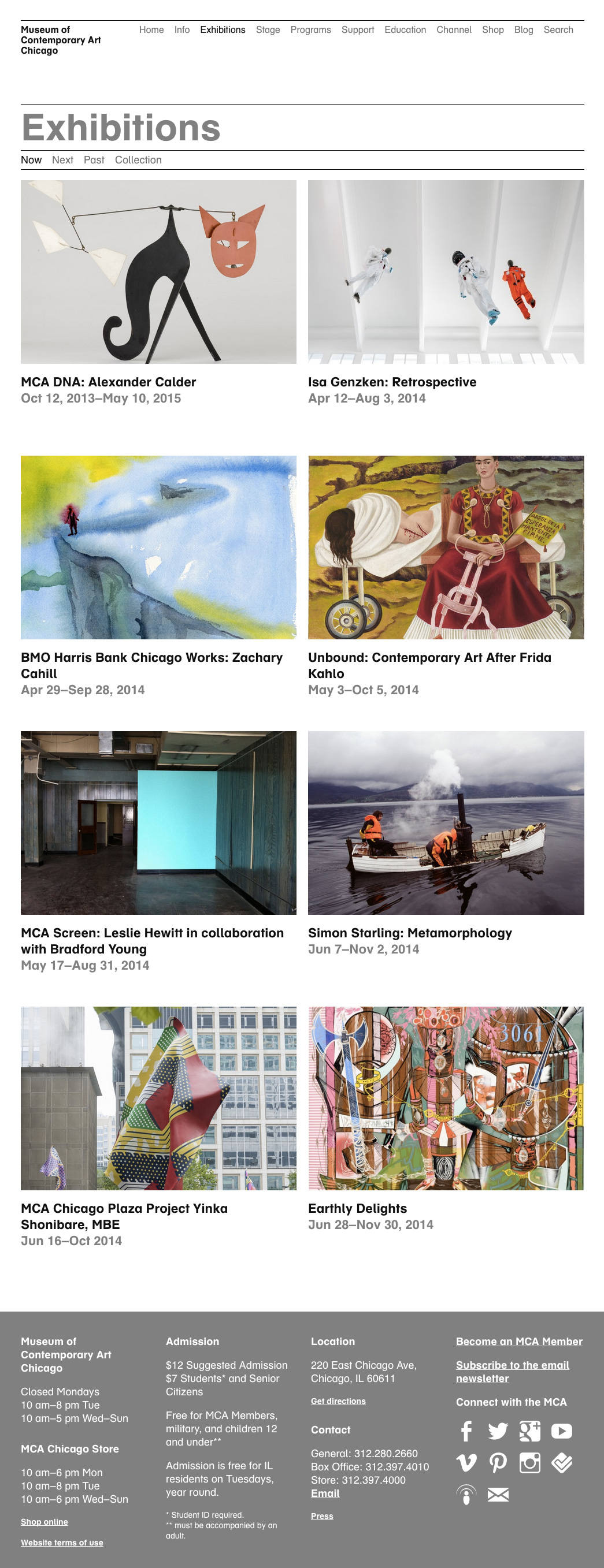
Exhibitions were created in WP as a custom post type. Knowing we had hundreds of records, we configured this type to be non-hierarchical, like Posts (hierarchical types, like Pages, run into performance problems with large sets). To match our data, three custom-field metaboxes were added the Edit screen: Start Date, End Date and Read Dates; other data was input into WP’s standard fields. Records were migrated manually, providing the opportunity to clean the content (remove dead links, etc) and update the accompanying images.
A “redirect” field was added to the legacy CodeIgniter CMS and was populated with the URL of the corresponding WordPress permalink. Using this data, the CodeIgniter templates redirected visitors from the legacy pages to the new, WordPress versions. In this way the migration was rolled-out incrementally, as records were completed.
Migrating the Exhibition Category Pages
Exhibition records were organized into a custom taxonomy called “Exhibition Categories,” which was used to generate the Past Exhibitions pages. During the first stage of the work, these taxonomy archives were redirected to the URLs of their CodeIgniter counterparts. Once the migration of the individual records was complete, the Exhibition Category templates were fully implemented and the redirect removed.
All exhibition records were filed in the appropriate “Past Exhibitions” category, even if the show had not yet completed. The taxonomy archive templates then used the Exhibition’s “End Date” custom field to filter out current and upcoming shows, displaying only those that had closed.
The last element was the Current and Upcoming Exhibitions pages. These were created as WordPress Pages containing custom loops which look up and display exhibitions with the appropriate Start and End Date custom fields. Here’s an example of the WordPress code:
The CodeIgniter versions of these pages were then redirected to their WP counterparts, completing the migration.
Project Team
Marty Spellerberg, Principal, Spellerberg Associates
Sarah Wambold, Former Director of Digital Media, Museum of Contemporary Art Chicago
Marian Oman, Content Coordinator, Spellerberg Associates
Shauna Skalitzky, Assistant Editor, Museum of Contemporary Art Chicago