MCN
Presentation at MCN 2015: WordPress as Museum Web CMS
I’ll presenting a session at MCN2015 in Minneapolis this November, in collaboration with Sarah Wambold. Titled WordPress as Museum Web CMS: Development and Content Strategy, the core audience for this discussion will be web teams considering implementing a CMS (or switching from another), are evaluating WordPress and want to know what to expect. From the description:
A look at three Museums using WordPress as their primary web CMS. Glance under the hood at implementations for the Museum of Contemporary Art Chicago, the Santa Cruz Museum of Art and History, and the Clyfford Still Museum.
Panelists will discuss how the each institution’s needs are manifested in code. What’s the same and what’s different; what’s off-the-shelf, and what’s custom? We’ll also consider WordPress’ impact on content strategy. What workflows does it enable; and what approaches fit with different institutional structures?
MCN (Museum Computer Network) attracts hundreds of attendees from around the cultural heritage sector to explore the latest advances in museum technology.
We’ll be presenting on Friday, November 6. Hope to see you there!
Presentation at MCN 2016: National Museum Website Visitor Motivation Survey
a membership-based professional association that provides a space for museum professionals to connect, share resources and best practices, develop their careers, and advance digital transformation in museums. Hosted every year since 1968, MCN’s Annual Conference draws over 600 cultural heritage professionals from museums, historic sites and visitor attractions in North America and beyond. Each conference features a variety of interactions and professional development opportunities.
In 2016 the conference took place in New Orleans. I led a 60-Minute Professional Session that included Alli Burness (ThinkPlace), Susan Edwards (The Hammer Museum), Jacques Haba (Nasher Sculpture Center), Jonathan Munar (Art21), Tricia Robson (Fine Arts Museums of San Francisco), Sarah Wambold (Clyfford Still Museum) and Jessica Warchall (The Andy Warhol Museum).
The subject of our presentation was…
In 2015-16, cultural organizations across the United States, joined by partners in Canada and Australia, banded together to better understand museum website visitor motivation. This was not just a research study, but a community of museums looking to better understand their online audiences.
The survey comprised a single question about what motivated users in going to the website that day. Focussing on identity-related motivations (rather than demographics or behaviors), the survey responses aligned with museum researcher John Falk’s Predictive Model for Museum Visitation—Explorer, Facilitator, Professional/Hobbyist, Recharger, and Seeker.
Led by Sarah Wambold, Director of Digital Media at the Clyfford Still Museum, and Marty Spellerberg, of Spellerberg Associates, the project culls more than 16 weeks of data across 23 different museum websites. This is the first survey to utilize Falk’s framework online, the first focused primarily on small- and medium-sized organizations, and the first in the US to view the data in aggregate.
The study provided representatives from participating museums the opportunity to discuss their findings, highlighting patterns that emerged across the various institutions. In order to facilitate those exchanges, professionals from each institution have met online using Slack, asking questions and sharing knowledge. In this forum we will bring this dialogue to life and the voices of MCN attendees into the conversation.
Presentations at MCN 2018

a membership-based professional association that provides a space for museum professionals to connect, share resources and best practices, develop their careers, and advance digital transformation in museums. Hosted every year since 1968, MCN’s Annual Conference draws over 600 cultural heritage professionals from museums, historic sites and visitor attractions in North America and beyond. Each conference features a variety of interactions and professional development opportunities.
This year the conference is taking place in Denver, and I’m involved in three presentations.
Proud to be Flesh: Cultural Spaces After the Internet (A conversation between museum technologists and local artists)
Exchange big ideas on complex topics with local artists and practitioners at this conversation-in-the-round about the impact of the Internet on cultural spaces. Now that a generation has grown up not knowing a world without the Internet, has the question evolved from “Do cultural institutions need to be online?” to “Do cultural institutions need to have physical spaces?” Consider the work of artists such as Yayoi Kusama and Kara Walker, whose work was so prolific on Instagram, Art In America reported that even arts professionals “willfully refrained from seeing [the work] … because they felt that they had already sufficiently experienced the piece.”
This unmoderated exchange, facilitated by local arts organization Tilt West, will explore the nature and relevance of digitally-influenced physical spaces, providing a rare opportunity for heady dialogue and a chance to experience a slice of the Denver art scene. Participants will journey offsite to a lesser-known art space to exchange ideas, evolve perspectives, and make connections across disciplines.
Understanding our audiences: The Whitney’s Website Visitor Survey and its broader context
This session will share learnings from the Whitney’s recent website visitor motivation survey, and review how these resonate with the recent Museum VMS paper published in the Journal of Digital and Social Media Marketing. We will cover methodological approaches and findings, as well as the usage of motivation as a key variable to define website segmentation. The Whitney’s results will be reviewed in the context of ongoing efforts to understand the intersectionality of museum audiences, and the development of human-first approaches, blending an understanding of user intent and action to measure more meaningful behavior and engagement.
Drawing on case studies from the Met and the Tate, we’ll look at how these studies influence decisions in the digital roadmap of these institutions.The ongoing exploration of visitor motivation and the public sharing of the results at conferences and in peer-reviewed journals represents an important dialogue that is stimulating the evolution of websites and digital content. By demonstrating how museums gain insights into audience motivations and behaviors, the session endeavors to spur more museums to conduct VMS projects. The audience will learn how to implement VMS projects at their own institutions, how to analyze the results, and make use of the data.
Emotion, Intimacy and Space: Designing and Developing the Clyfford Still Museum’s In-Gallery Video Kiosk System
This case-study session will present insight into how digital design can reflect the physical space in which it is installed, how graphic and movement choices affect visitors’ sense of intimacy, and how the interactive components of museum visitors’ experience can be made approachable through the collaborating disciplines of design and development. The Clyfford Still Museum’s in-gallery kiosk system acts as an interactive library that makes accessible to visitors the full archive of videos commissioned by the museum, with every aspect of the design having been considered in terms of user experience.
We will demonstrate how a content-management back-end allows the visitor-facing presentation to scale with the museum, and how this can be achieved while fitting into a museum’s established technology stack. We will cover how advanced features of WordPress, including the REST and Caching APIs, can be used to power a React-based front-end.
MCN Field Trips Open up Dialog With Host-City Artists
This piece is cross-posted on the MCN Blog.
MCN is all about facilitating connections for museum professionals. For the 2018 conference in Denver, I was fortunate to have the opportunity to help introduce a new format, MCN Field Trips, that opened up opportunities for spatial and dialectic exploration.
The day before the conference has always been an opportunity for attendees to tour cultural sites or take a deep dive into a topic in a workshop. This year, museum pros also had the chance to venture out into the community to engage with local artists in their home venues. By introducing visiting cultural technologists into an established discussion series favored by Denver practitioners, the Field Trips program facilitated the exposure of these communities to each other’s concerns and points-of-view.
Denver’s two Field Trips took place on Tuesday, November 13 2018. About half of the attendees came from MCN, and half from Tilt West, a Denver non-profit that promotes critical discourse on arts and culture. Each discussion dealt with aspects of our relationship to the internet, as individuals and cultural workers.
“Proud To Be Flesh”
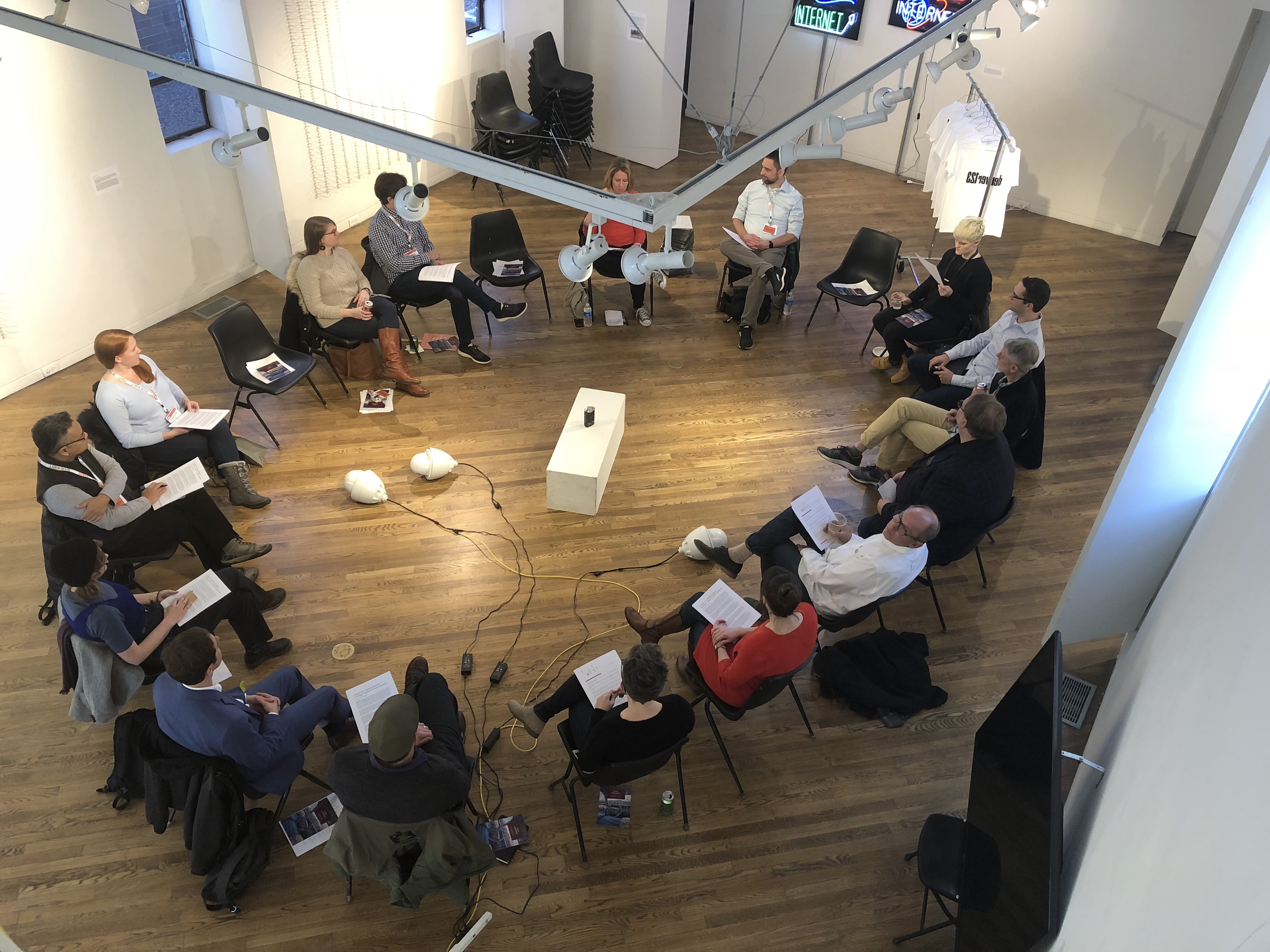
The first Field Trip, Proud to be Flesh: Cultural Spaces After the Internet, took place at Next Stage Collaborative, an interactive gallery space located in the Denver Performing Arts Complex and administered by the University of Colorado Denver and Denver Arts & Venues.
I wrote and delivered the discussion prompt, which can be read online. In it I attempted to survey the contemporary relationship between online and offline cultural spaces, motivated by the question:
“As much of the world moves online, what’s next for engaging, enriching, in-real-life experiences of art and culture?”
The discussion, which was recorded, grappled with the structure of cultural organizations digital departments and their engagement with social media influencers, as well as the effects of online networks on artist communities and new forms such as Instagram-ready selfie spaces. It was complemented by the environment in which it took place, an installation / performance venue titled Special Guest, presented by Meow Wolf and created in collaboration with local artists.
Following the discussion, Tilt West commissioned a response from Meagan Estep. Her piece, which can be read on Medium, expanded on my question to ask:
“With both digital and physical experiences blended in a museum setting, can we even distinguish one from the other? Are they even separate?”
“Nightmare Machines”
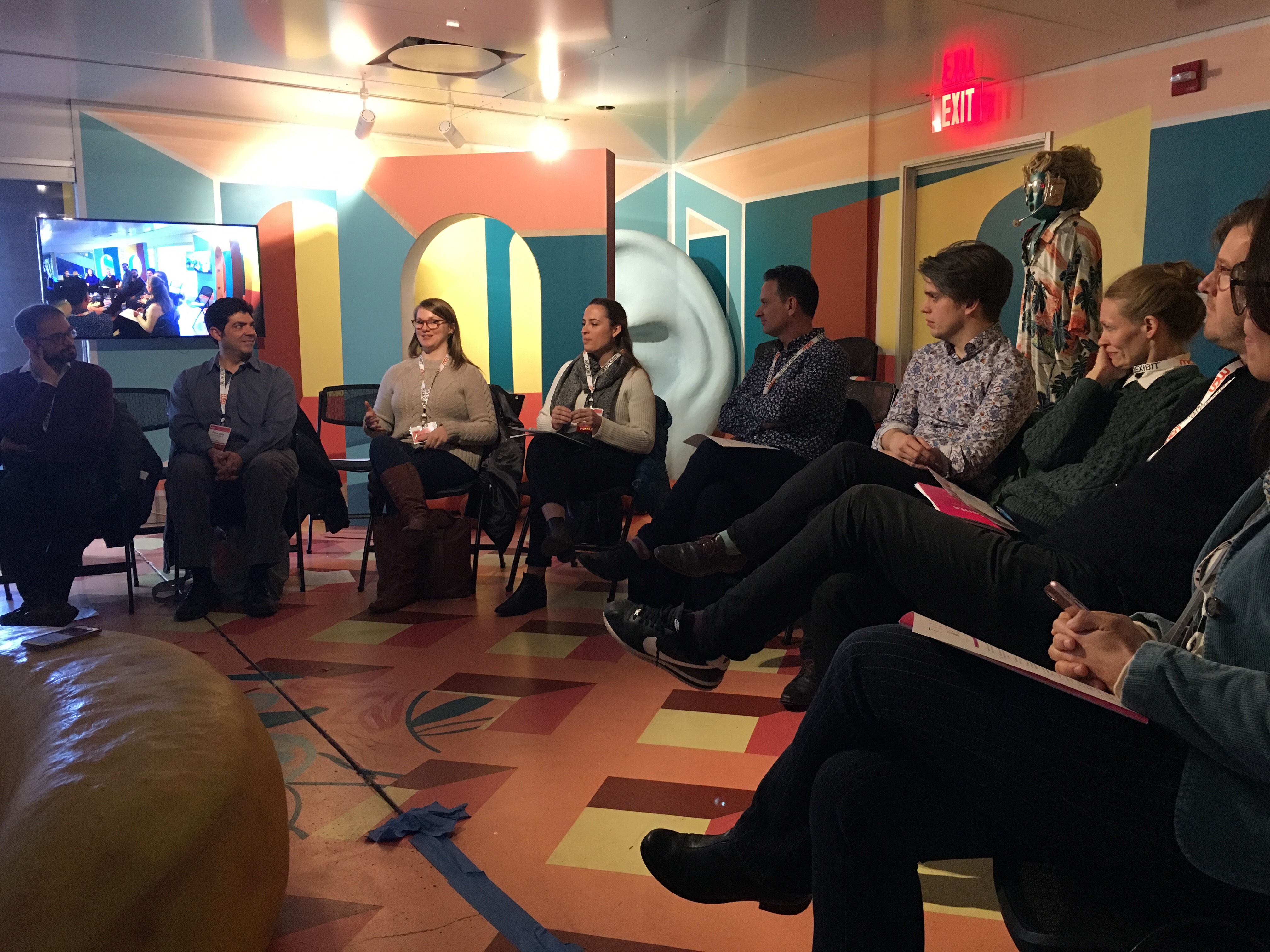
The second Field Trip, Computer Lib / Nightmare Machines: Technology’s Impact on Cultural Communities, took place at Emmanuel Gallery, a non-profit art facility housed in Denver’s oldest standing church structure and situated on the Auraria Campus.
Sarah Wambold prepared and delivered the prompt, a version of which can be read online, examining the broken promises of digital technology utopianism. The discussion, which was recorded, grappled with cultural organizations’ complicity with an online culture of frightening user tracking, and user’s changing expectations of privacy. It, too, was complemented by the environment in which it took place, artist Aram Bartholl’s exhibition, Your Shopping Cart Is Empty, which presents work created at “an interplay between internet, culture and reality.”
How do our taken-for-granted communication channels influence us? Bartholl asks not just what humans are doing with media, but what media is doing with humans. Tensions between public and private, online and offline, techno-lust and everyday life are at the core of his work.
— Emmanuel Gallery
Following the discussion, Tilt West commissioned a response from Matt Popke. His piece, Nightmares of Our Own Making, examines the event’s themes in relation to The Cluetrain Manifesto, an essay that has had influence within Silicon Valley.
A Foundation for Growth
The 2018 Field Trips were developed at the intersection of MCN and Tilt West. This intersection was manifested in the person of Sarah Wambold, the Clyfford Still Museum’s Director of Digital Media, an MCN 2018 Local Committee member and Tilt West founder. The success of the program is in large part a credit to her vision and organization. As well, our appreciation extendeds to Jeff Lambson, Director of Emmanuel Gallery, for facilitating use of the venues.
In my view, the Field Trip format adds depth to the MCN offering, directly supporting the organization’s mission and expanding its reach. I hope that its success in Denver paves the way for the program to grow in 2019 and beyond.