Text
Museums, Collections and Art
This is the first part of my notes on Museums By Artists, edited by A. A. Bronson & Peggy Gale and published by Art Metropole in 1983. Phrases have been lifted from the text, then grouped with like. See also: Collecting as an Artistic Mode.

Daniel Buren
Museums by Artists (Poster), 1983
Art Metropole Toronto Canada
56.6 x 78.5 x cm.
The museum has history, volume, physical presence, and cultural weight. Its function is aesthetic, economic and mystical.(1) No museum is able merely to exhibit contemporary art.(2)
Both “public” and “private” institutions are political.(3) The museum is a power symbol,(4) and carries social and political connotations.(3) It has become a necessary symbol of the city and the culture of the city. It is a symbol of the culture of the new rich, dignifying the power, status and tastes of the central Government and financiers.(2) These are the employers who set the boundaries for decisions made by museum officials and “some museums do not think they have sufficient independence to exhibit a portrait of their own structure.”(3)
Museums convert the aesthetic construct into an object of contemplation, transforming the primary language of art into the secondary language of culture and disseminating the abstracted meaning(5). Primarily framing devices for the urge to collect,(4) museums select, acquire and protect work, sheltering it from questioning. Museums “act as a refuge, without which no work can exist.”(1)
A museum’s collection is a “whole,” forming a context having various foci. Works are brought together based on associability (period, quality, form, culture), producing a harmonization of some aspects but exhausting others.(6) The result is a simplification of a work’s historical and psychological weight.(1)
In social/group exhibitions, varied / un-alike artists are shown together. This serves to compare the otherwise incomparable, lending impact to the chosen works and resulting in the “warped” discourse that creates opposing schools and movements. In contrast, single-artist exhibitions have a flattening effect, stressing the differences within a single body of work. There is an economic insistence on “miraculous, successful” works versus those that have “failed,” as the former boost the sales value of latter, through association.(1)
“A museum is the collection of an institution and it’s an anthology. A few anthologies are all right, but some hundred in the United States alone is ridiculous. It’s freshmen English forever and never no more no literature.”(2)
The place of showing marks and imprints the work.(1) In this context, art elevates awareness of its specific social situation and function to the status of “theme”.(7) The “history still to be made” is integral to this work; art only exists in, and is destined for, a museum. The museum becomes the single the cultural-visual viewpoint from which a work can be considered. “Everything the museum shows is only considered and produced in view of being set in it.”(1)
A collection is an excuse for the building housing it. More money is spent on architecture in the name of art than on the art itself.(2) “What is a museum without clearly defined rooms? An enormous burden for art.” The ideal presentation is one which allows the eye to perceive the works’ readiness to participate.(6) But surprisingly, no special attention is paid to this place.(1)
The institutional architectural language is characterized by the false neutrality of white walls and false timelessness and immobility of placement.(5) Art is treated as eternal, obviating temporality.(1) Works are preserved from decay(5) and shown for a long time in unchanging environments, causing them to lose their suddenness, their unique element of surprise.(6) Extracted from any original context and function,(5) works appear to have fallen from heaven, detached, as if created by the museum itself.(6) (This is considered natural but is only historical, our present day ideas of preservation having been inherited from 19th century.(1))
This fate rarely corresponds with artist’s production intentions.(7) Living artists do not want to be embedded in the collection; they prefer to rise above them as a “dramatic voice related to their era.”(6)
Works of art are acts of decision, choice and self determination which undergo a material transformation through social interaction. The nature of this transformation belongs to the discourse surrounding them. This discourse takes place within the social institutions and historical circumstance that constitute the conditions of the work’s reception. The concerns artists choose to integrate within the conception of a work originate from anticipation of these conditions, its final distribution and institutional modes of reading.(5)
A “Fluxus Definition of Art” uses three stages of filters: Artificial, Non-Functional and Cultural. The Artificial begins by excluding all that is not human creation; the Non-functional (leisure) then excludes all which is essential to survival or to material progress; and, finally, the Cultural excludes all witch is without pretense to significance, profundity, seriousness, greatness, inspiration, elevation of mind, institutional value, exclusiveness. This leaves us with the Fine arts only: the literary, plastic, musical and kinetic.(8)
“In the work’s attempt to dissolve reification within the very medium and the site where they are produced, in the necessity to mimetically anticipate its subjection to ideology by inscribing itself as precisely as possible into those very systems that determine its historical status, it seem to fail to maintain any claim for autonomy and rupture in favor of a complacent, melancholic and passive contingency upon the conditions of rule that it set out to disrupt.”(5)
“Products which are considered ‘works of art’ have been singled out as culturally significant objects by those who at any given time and social stratum wield the power to confer the predicate ‘work of art’ unto them; they can not elevate themselves from the host of man-made objects simply on the basis of some inherent quality.”(3)
See also: Collecting as an Artistic Mode.
References
All from Museums by Artists, A. A. Bronson, Peggy Gale Editors, ISBN 0920956130.
- Daniel Buren. Function of the Museum / Function of the Studio / Function of Architecture: Notes on Work in Connection With the Places Where It Is Installed
- Donald Judd. On Installation
- Hans Haacke. All the Art That’s Fit to Show
- AA Bronson. The Humiliation of the Bureaucrat: Artist-Run Centers As Museums by Artists
- Benjamin Buchloh. The Museum Fictions of Marcel Broodthaers
- Jean-Christophe Ammann. A Few Modest Thoughts on the Prerequisites for Museums and Exhibits of Art, in Particular of Contemporary Art, and for Visitors to Such Museums and Exhibits
- Walter Grasskamp. Artists and Other Collectors
- George Maciunas. Fluxus (Its Historical Development and Relationship to Avant-Garde Movements)
Thank you Kathleen McLean.
Collecting as an Artistic Mode
This is the second part of my notes on Museums By Artists, edited by A. A. Bronson & Peggy Gale and published by Art Metropole in 1983. Phrases have been lifted from the text, then grouped with like. See also: Museums, Collections and Art.
Daniel Buren
Museums by Artists (Poster), 1983
Art Metropole Toronto Canada
56.6 x 78.5 x cm.
Collecting as an artistic mode has taken various forms throughout history. Early expressions include the collection of studio props and the assembling of the products of colleagues. Depictions of art collections are later joined by “collection pictures,” consisting of numerous small images.(1)
Cubists Braque and Picasso incorporated fragments from “reality” such as stenciled characters and facsimile materials into their pictures without the application of pictorial distortion.(2) This emergence of assemblage and collage signaled a reevaluation of collecting, but still within traditional media.(1)
Marcel Duchamp went further, declaring found objects themselves to be works of art and signing them.(2) Flowing from his self-definition as a flaneur who selects objects for ready-mades, he reduced the visibility of his paintings in favor of emphasis on material elements. In doing so he revealed the obsolesce both of Surrealism’s pictorial production and the retrospective exhibition format, anticipating “the ultimate destination of the object into the structural definition of the work.” Through his concern with placement, transport, evaluation, institutionalization, display and maintenance, Duchamp changed role of the artist as creator into that of collector and conservator.(3)
From its inception with works on canvas, the activity of isolation and reorganization of objects had grown in scale until it lay claim to largest possible setting for presentation, an evolution which lead to the employment of the organizational pattern of collecting — the “Artist’s Museum.” (1) In the hands of artists, a Museum could be used to clarify, heighten or counterpoint intent, or as the actual content or medium of production.(4) Even regarding indirect collections, such as the creation of an exhibit of a collection made or left over by another,(1) what mattered was not the origin of the collection but how, as found or transformed, it fit into the artist’s autonomous form or idea.(2)
“These are museums by artists. And what better place to develop the interior kingdom of the soul than in … this idealized vision of the ‘museum,’ of history, in which the artist animates the quaking body of the institution with his own obsessive will?”(4)
But to create ones own museum was simply to create a “little picture” on another scale. Artists found more success when they matched an object and place which dialectically implied each other. Such artists showed what a work implied in a given place, leading to a consideration of what the place itself implied. Work produced for the Museum must examine its influence. Or, going further, it’s impossible to conceive a work outside the place where it will be exhibited. And it follows that “work taking into consideration the place in which it is shown cannot be moved elsewhere and will have to disappear at the end of the exhibition.”
This, however, presented a challenge to the Museum’s inclination towards preservation and the narrative of “immortality” it desired to present.(5) And so in the 1960s and 70s, language-based art began to question the roles of institutions such as the museum, dealer, collector and public; rejecting object-centered assumptions of construction and sale, and the requirements of exhibition, collection and power hierarchy.(6)
In June and July of 1969, Iain and Ingrid Baxter of N.E. Thing Co. created an environment at the National Gallery of Canada, Ottawa. This performance was “a parable about gallery space” in which a national gallery was turned into an artistic venture commenting on its context. Reflecting “the building’s intended existence as an office complex,” they took over the first floor of the gallery to assemble the Company’s premises and products, with Iain Baxter going to the office every day to carry out the normal “business activities” of his art practice.(7)
The Documenta 5 exhibition of 1975 was “gesantkunstwerk,” using artists and works as if they were “dabs of paint in the panting.”(8) The expanse of collection was emancipated from subservience to artistic production, having become a form of production in its own right. “The collection as manifest outcome of artistic activity thus came to lay claim to the institutional setting which hitherto had been reserved for artist’s products.”(1)
The ultimate example may be bureaucracy as a museum by artists, as embodied by Canada’s Association of National Non-Profit Artists Centres (ANNPAC). Founded in 1976, the Association was a living museum resulting from the self determination of artist run spaces and lack of a viable art market or access to New York’s hype-system. It existed in an aura of hyper-aesthetic tension between idealism & poetic aspiration and the empirical realities of cash. Defined by democratic meetings and the lowest common denominator mechanisms of bureaucracy, artists participated in the nationally funded cultural character. (This is in contrast to the US, where they crumble under the entrepreneurial model.)
ANNPAC, a structure for the union of museums by artists, existed outside any particular physicalities. The continual, casual travel for exhibitions, performances and lectures was enabled by communications technology and the Canada Council’s program of travel grants, with publications and video serving as additional connective tissues. Intrinsically self-defining, they allowed communities of artists to recognize themselves as existing (for “we all know the importance of seeing ourselves”). The artist in this context inhabits flux of dream galleries, enacting the whole chain of art world beings.(4)
“The museum in the head is the place, the world, where a never static sum of speculations feed from diverse sources struggle for visualization.”(8)
See also: Museums, Collections and Art.
References
All from Museums by Artists, A. A. Bronson, Peggy Gale Editors, ISBN 0920956130.
- Walter Grasskamp. Artists and Other Collectors
- Claes Oldenburg. Mouse Museum
- Benjamin Buchloh. The Museum Fictions of Marcel Broodthaers
- AA Bronson. The Humiliation of the Bureaucrat: Artist-Run Centers As Museums by Artists
- Daniel Buren. Function of the Museum / Function of the Studio / Function of Architecture: Notes on Work in Connection With the Places Where It Is Installed
- Peggy Gale. Introduction
- N.E. Thing Co. Ltd.
- Harald Szeemann. Museum of Obsessions
Thank you Kathleen McLean.
Harald Szeemann and Daniel Buren in Documenta 5
Following my notes on Museums By Artists, I was interested to hear more from Daniel Buren on Harald Szeemann and Documenta 5. Luckily, filmmaker Jef Cornelis recently issued an archive of footage from that exhibition, including interviews with the two men. I have transcribed their comments here, including Buren’s clear articulation of his thesis.
Harald Szeemann
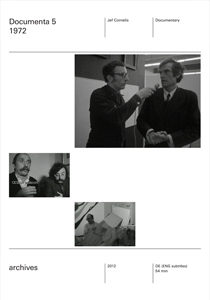
DVD cover of Jef Cornelis’ film Documenta 5 (1972)
We planned this “documenta Urbana” which was, in a way, Mr. Bode’s dream. We also had the documenta seminar, which was Mr. Brock’s dream. But neither one can guarantee documenta’s status as an event, which is the only thing that will bring people to Kassel. And this town really needs visitors during the documenta.
After a certain period of reflection, there was only one possibility which would once again bring a quarter of a million visitors here: by making the most of the prestigious status art possesses in the world, but in order to say something different.
… documenta 5, for many people, it’s been a stabilising force. Various artists, who see themselves as subversive, see no alternative than to remain in the museum context, which is the only context giving meaning to their work.
Q: But it was still you who —
It would be ridiculous to deny it. And I think, from the start, I asked, I demanded that I have that power. I insisted that they replace the committee and give me total responsibility for this exhibition. Otherwise I couldn’t do it.
… It’s clear that a seminar would have been the purest form, and most suited to the situation in 1970. So no visitors. Naturally, we’ve tried in these two years to retain that thematic aspect, to break away from the notion of a modern art exhibition. But at the same time, we couldn’t just ignore the original idea, to make it an event, to draw attention, for the same ten per cent of the visitors, to the didactic aspect of the exhibition.
Daniel Buren
(I’m) displaying my work, the paintings, in this unusual place, in different sections, all throughout the articulation of the exhibition, between the two museums which constitute documenta.
Q: Only inside?
Only inside, yes. Because I think this exhibition, the way it’s divided into sections, moving from one section to another is like going from inside to outside, but within the overall whole that is the exhibition. From one section to another, you go from the inside to the outside.
Q: Have other artists agreed to use your work as a backdrop?
I should say that I wouldn’t have asked.
Q: But there weren’t any problems?
Not so far.
Q: Is it modesty or… Why did you choose such neutral colours?
The colors I chose are theoretical and technical at the same time. In order to bring this idea to fruition, the work had to have absolutely no visual importance, no real importance. So I had to choose something very neutral, very soft. The only way to achieve that restrained tonality was to choose white on white, which poses other problems.
Q: Do you think the public will be suspicious of that?
It doesn’t matter.
… The demonstration is parallel to the demonstration by the curator, Szeeman. The work sort of becomes part of the museum, in which we have come and hang our artworks. Or installations or performances, etc.
Q: So you’re saying Szeeman has himself created a big artwork?
Documenta is characteristic, in a way. As are almost all exhibitions. But it’s very visible here. Harald Szeeman is the artist who has created this enormous painting, which happens to be the exhibition itself. So the exhibition is an exhibition of an exhibition.
… To my surprise, all the artists here are prepared to be put in boxes.
Q: What boxes?
Each room is a box. And you have a label, a title, you’re classified. And we each install ourselves to fit the box.
… We still haven’t emerged from the 19th century. We’re still in the world of pictures. Art is still a series of pictures. Be they conceptual or hyperrralist. We each hang up our picture, which is sort of the meaning that I’m trying to convey, inasmuch as we’re hanging a picture on something. The picture is just there in its own right.
Q: And that’s a 19th century notion?
I think it’s 19th century, it’s also 20th century, which is nearing its end. Although we’ve all been pondering this problem for nearly a century, it still hasn’t been dealt with. It’s still all about pictures and metaphors. It’s interesting and questionable that metaphors exist here, in the idea of a museum exhibiting a museum.