WordPress
Page 5 of 5
Presentation at MCN 2015: WordPress as Museum Web CMS
I’ll presenting a session at MCN2015 in Minneapolis this November, in collaboration with Sarah Wambold. Titled WordPress as Museum Web CMS: Development and Content Strategy, the core audience for this discussion will be web teams considering implementing a CMS (or switching from another), are evaluating WordPress and want to know what to expect. From the description:
A look at three Museums using WordPress as their primary web CMS. Glance under the hood at implementations for the Museum of Contemporary Art Chicago, the Santa Cruz Museum of Art and History, and the Clyfford Still Museum.
Panelists will discuss how the each institution’s needs are manifested in code. What’s the same and what’s different; what’s off-the-shelf, and what’s custom? We’ll also consider WordPress’ impact on content strategy. What workflows does it enable; and what approaches fit with different institutional structures?
MCN (Museum Computer Network) attracts hundreds of attendees from around the cultural heritage sector to explore the latest advances in museum technology.
We’ll be presenting on Friday, November 6. Hope to see you there!
Web development for architecture blog Common Edge

Founded by Martin C. Pedersen and Steven Bingler, Common Edge is a non-profit organization dedicated to “reconnecting architecture and design with the public that it’s meant to serve.” The website features essays, interviews and commentary by architects and thinkers in the field.
The website was designed by Nikki Chung and Dungjai Pungauthaikan of Once-Future Office, and developed by yours truly.
Web development for Joel Sanders Architecture

Led by Principal Joel Sanders, JSA “creates innovative and sustainable environments in response to today’s rapidly changing culture.” Sanders is a Professor of Architecture at Yale University and former Director of the Graduate Program in Architecture at Parsons School of Design.
The site was designed by Everything Type Company and developed by yours truly.
Web development for artist Mel Chin’s The Tie That Binds

I’m happy to have launched the website for artist Mel Chin’s land art project, The Tie That Binds, part of CURRENT:LA Water, Los Angeles’s inaugural public art biennial.
Originally from Houston Texas, Mel Chin is known for works that require multi-disciplinary, collaborative teamwork that conjoin cross-cultural aesthetics with complex ideas.
The Tie That Binds begins at an 18-acre post-industrial lot along the LA River known as the Bowtie . Visitors, who are guided through eight unique, drought-resistant sample gardens, can then commit to creating a mirror garden in their own yard. Participants receive a blueprint for one of the 512 different designs and instructions on how to plant, establish, and maintain their mirror garden. The newly planted gardens in yards all over the city are meant to reflect a future drought-resistant, collective landscape for LA.
Our team worked closely with Mr. Chin to determine the website’s direction, establishing that its primary purpose would be to drive public visitation to the Bowtie (rather than, say, serve as a “catalogue” or archive). The website, along with the project’s identity and graphic materials, was designed by LA-based designer Tom Kracauer; I provided WordPress and mobile-responsive front-end development; and Amanda Wiles, of Mel Chin Studio, handles maintenance of content.
Thank you to the project team for a great experience; and thanks also to LA arts organization Clockshop for putting us all together!
Check out The Tie That Binds.
Membership microsite refresh for the Santa Cruz Museum of Art and History
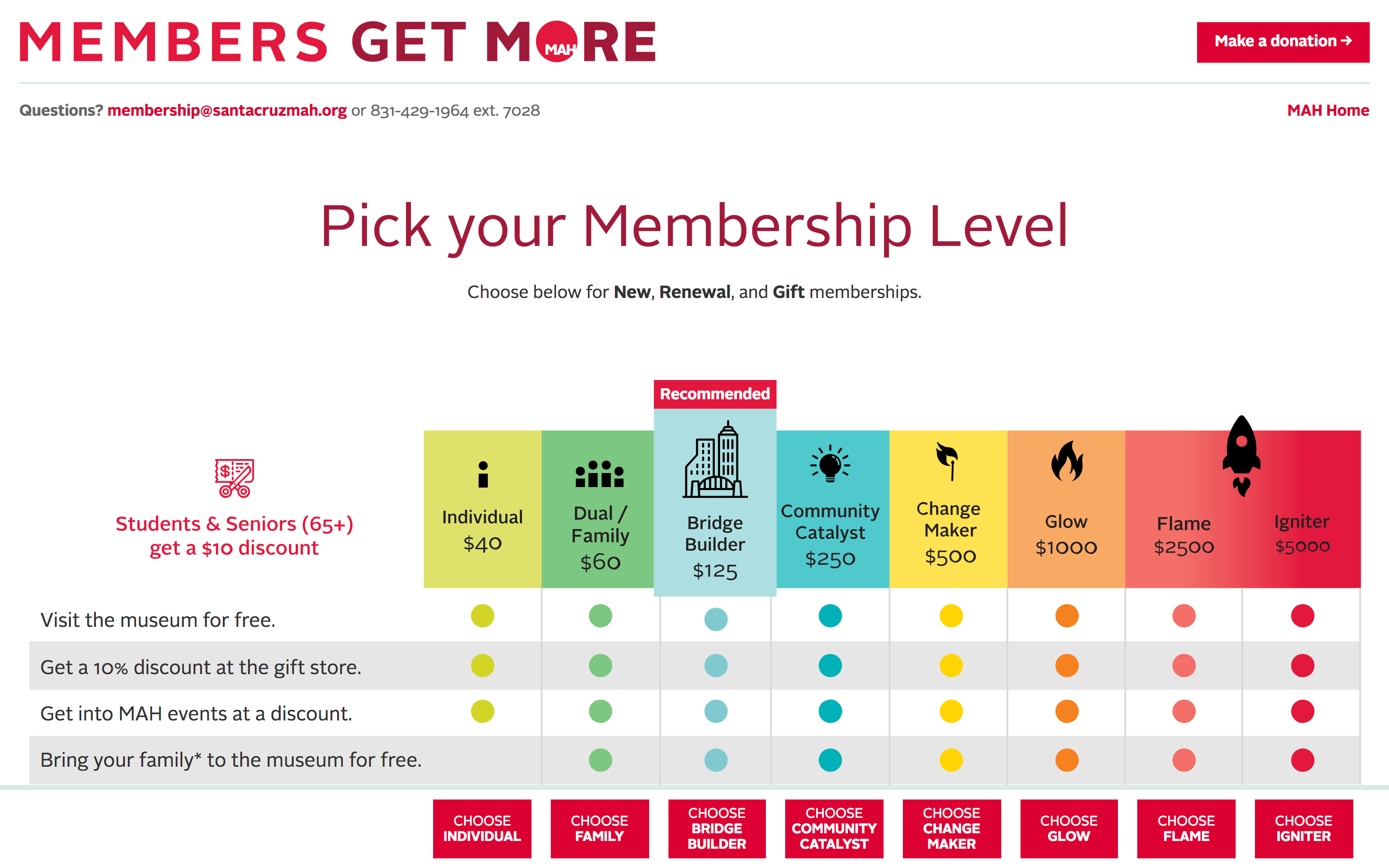
As part of our ongoing work with The Santa Cruz MAH, we recently refreshed the microsite used for membership renewals. The site is build on WordPress and Gravity Forms, with various plugins providing functionality including those from For Gravity, gravity+ and Gravity Wiz.
Presentations at WordCamp DC & WordCamp Austin, 2017
In 2017 I presented at two WordCamps: DC with Desi González, and Austin with Zack Rothauser.

Here’s how we described the DC talk:
In May 2017, The Andy Warhol Museum in Pittsburgh, PA rolled out a redesigned website, built on on WordPress. In addition to taking advantage of an easy-to-use content management system and a strong open-source community, the move to WordPress opened opportunities to solve perennial museum website problems.
We will discuss the development of the website’s content strategy and design, informed by analytics and qualitative user research. We will demonstrate the ways we built the new site to solve specific museum and user needs, including designing a system of flexible page templates, solving event calendar challenges, and implementing systems/workflows for managing intellectual property restrictions for collection images.
And here’s how we described Austin:
This talk will present a look under the hood of some WordPress-powered museum projects. We’ll explore WordPress as a solution to a variety of common problems, including powering websites, digital publications and in-gallery experiences. Our lens will be recent projects for the The Andy Warhol Museum, Pittsburgh; The Clyfford Still Museum, Denver; The Santa Cruz Museum of Art and History and others.
In addition to taking advantage of an easy-to-use content management system and a strong open-source community, WordPress opens up opportunities to solve perennial museum website problems. We will discuss the development of museum websites’ content strategy and design, informed by analytics and qualitative user research. Additionally, we will demonstrate the ways we’ve solved specific museum and user needs, including designing a system of flexible page templates, solving event calendar challenges, and implementing systems/workflows for managing intellectual property restrictions for collection images. We will also explore how WordPress can be used to power experiences outside of traditional websites, including membership renewal and constituent management, online exhibition catalogues and touchscreen video kiosks.
Bringing Warhol to Life Online: Strategy, Design, and Accessibility for warhol.org
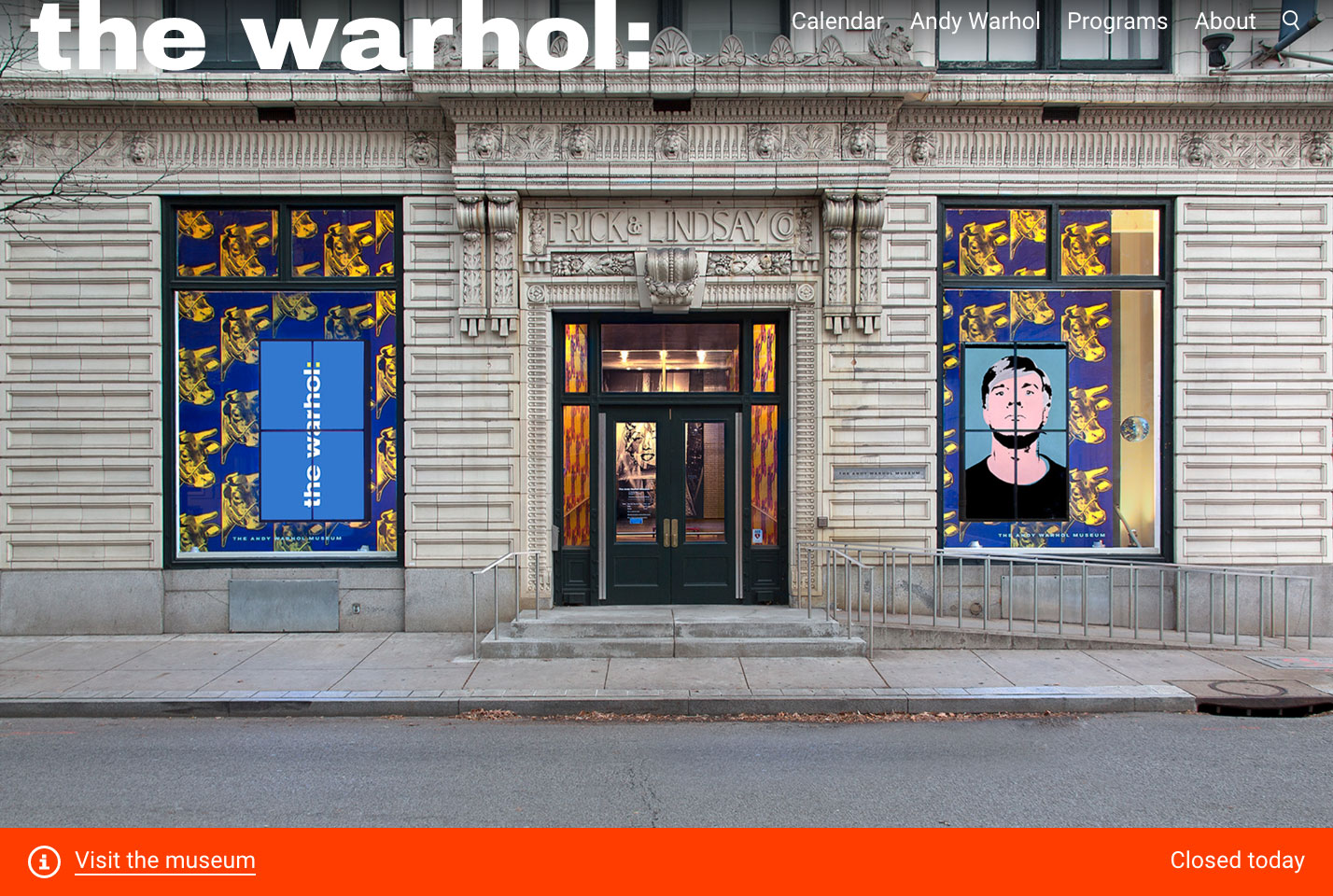
We worked The Andy Warhol Museum, conducting a comprehensive overhaul of warhol.org. Launched in May 2017, The redesign included migrating the backend to WordPress, redesigning the frontend, establishing a content strategy, implementing a new information architecture, and auditing and rewriting all text and images.
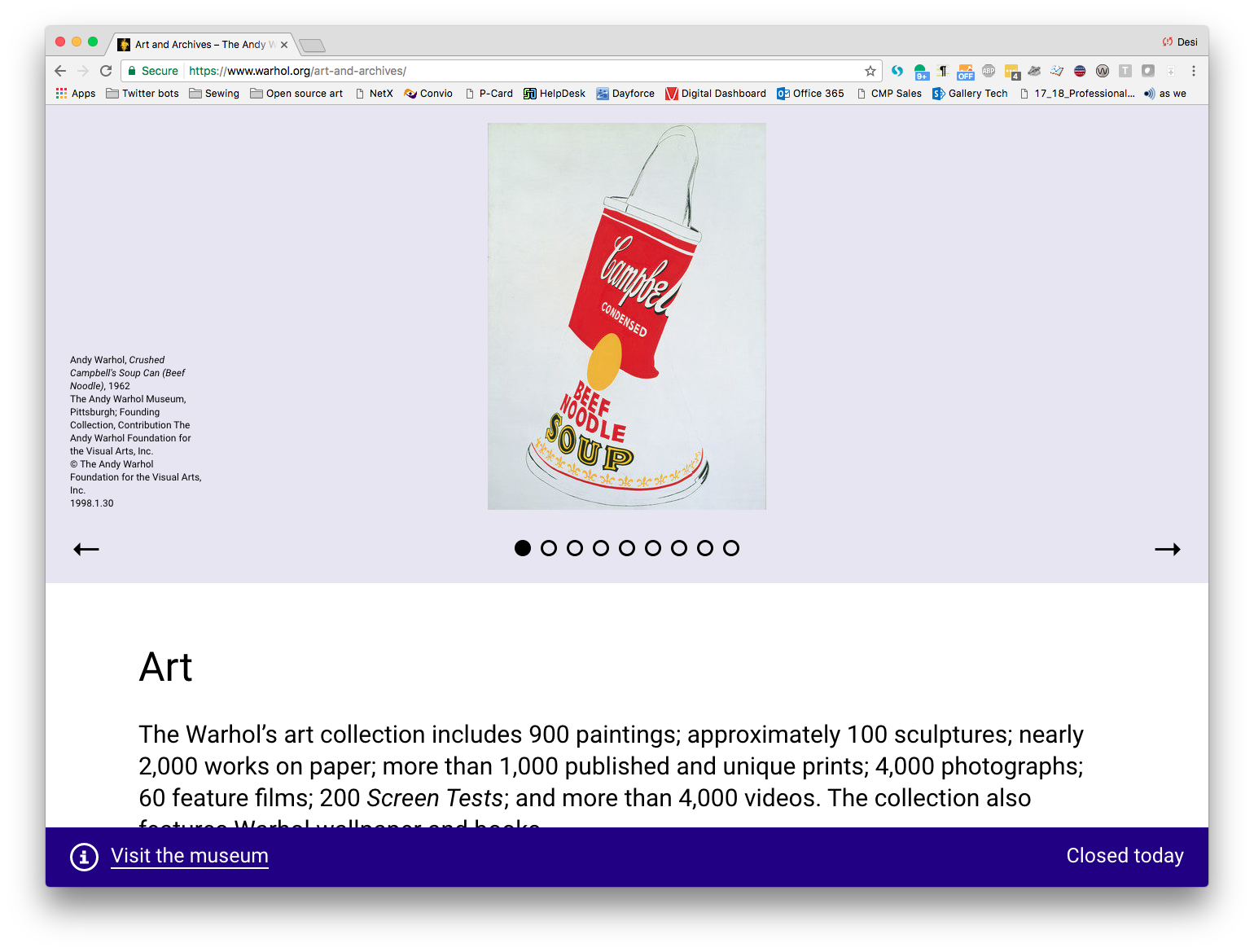
The new warhol.org is conceived primarily as a communications tool for audiences planning to visit the museum or attend a program, with a secondary goal of providing much sought-after content on Warhol to digital visitors across the globe.The mobile-first design relies on bright colors, expressive typography, and images of visitors engaged in art making and art viewing. The homepage has been reimagined to highlight the unique, active experience of being at The Warhol: as a visitor, you can make art in our Factory studio, play with floating pillow-shaped balloons in the Silver Clouds installation, or star in your very own screen test. The new site is also highlights the rich work and life of Andy Warhol. Our Life page, for example, tells Warhol’s story as illustrated through collection objects.
The content strategy for the The Warhol’s website redesign was informed by the Visitor Motivation Survey that the museum participated in a year prior. Through this research, the staff at the Warhol Museum decided to prioritize local and tourist audiences planning a visit, focussing on the website as a communications tool first and foremost.
Working with staff at the museum, we developed detailed user personas, completed card sort activities, and created journey maps to facilitate a new approach to the information architecture for the site. The result is a website that speaks clearly and directly to audiences looking to engage with the museum through a visit or a program.
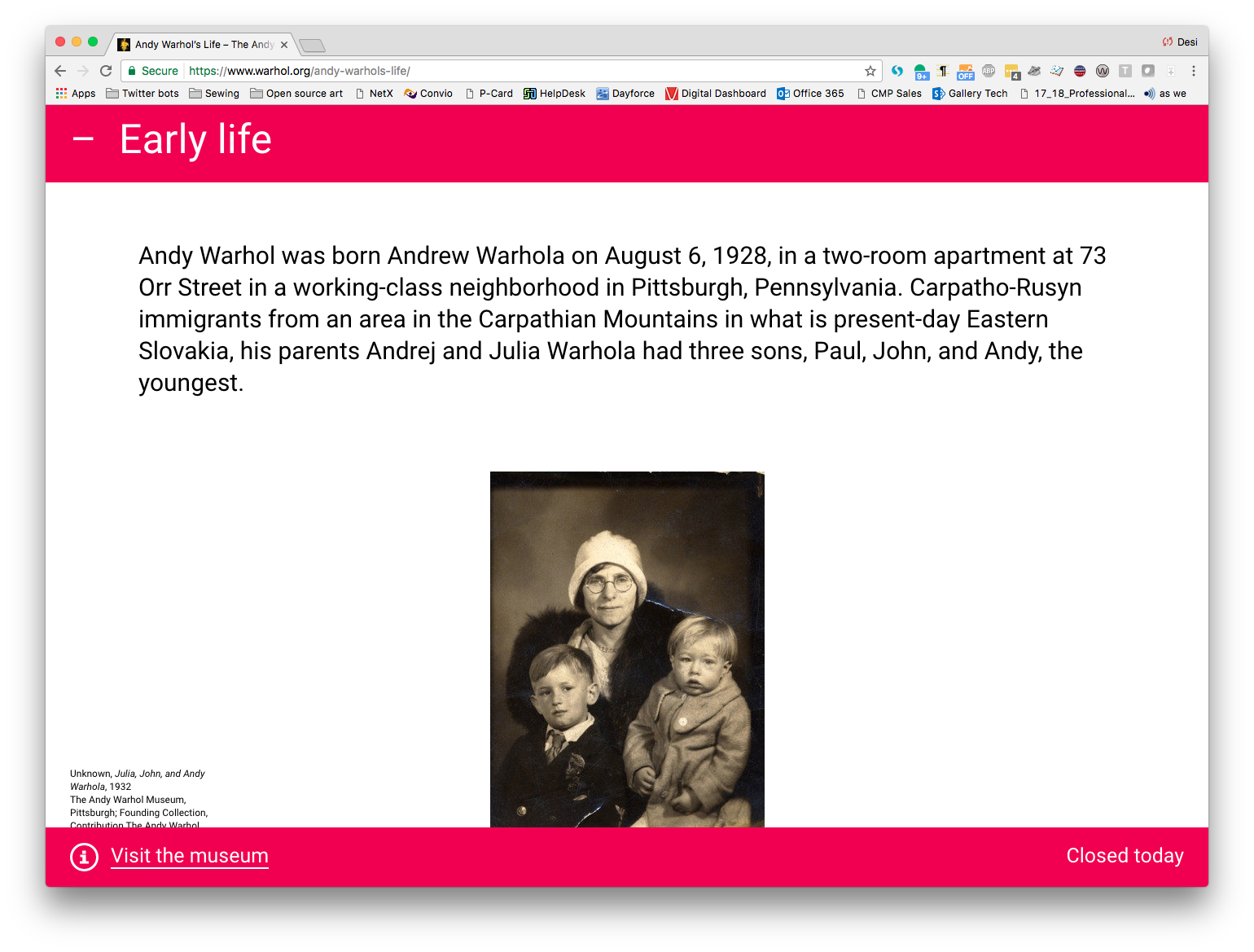
We worked with Prime Access Consulting, led by Sina Bahram, president, to make warhol.org accessible to users with a wide range of abilities and preferences. The site achieves WCAG (Web Content Accessibility Guidelines) 2.0 AA compliance and improves the web experience for visitors across a spectrum of abilities, including those who are deaf or hard of hearing; interact with the site via only keyboard or mouse due to limited mobility/motor control; people who are blind or have low vision and use a screen reader or employ zoom tools to enlarge the page; and users with cognitive disabilities.
Desi González, who was then The Warhol’s Manager of Digital Engagement, served as project manager and user experience lead, leading a core team that included Danielle Linzer and Jessica Warchall; and working with staff across the museum to redesign the site. We brought on Everything Type Company as our design partner. Zack Rothauser, Andrea Skeries and Daniel Abernathy contributed development. Sarah Wambold contributed to the content strategy.
Presentation at WordCamp NYC 2018
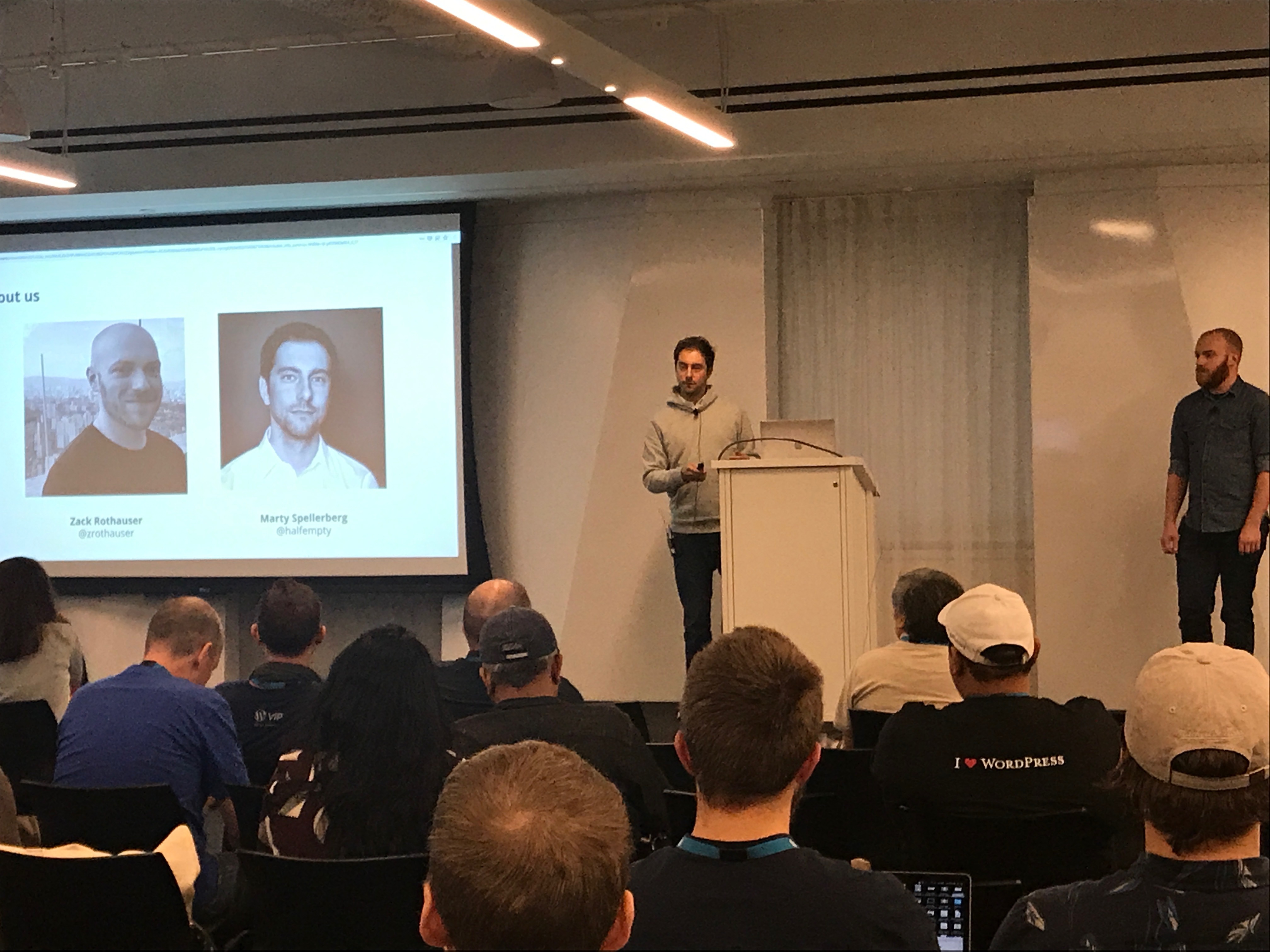
Zack Rothauser and I will be heading to WordCamp NYC 2018 to give a presentation on the Clyfford Still Museum’s web-based touchscreen video platform.
Since the introduction of the WordPress REST API, the potential for using it to power React applications has generated much excitement among developers. But what is an actual use-case for these technologies, and how can it improve the user experience? In this presentation we’ll show how WordPress was used as a foundation for building an in-gallery video kiosk for the Clyfford Still Museum.
We’ll begin by looking at the design process for a museum experience: How digital design can reflect the physical space in which it is installed, and how graphic and movement choices affect visitors’ sense of intimacy. We’ll show how the video kiosk platform was built to scale with the museum’s growing video library, how we made the videos accessible to people with hearing impairments, and how we designed the system to be content-managed from afar.
From there, we’ll demonstrate how content-management via WordPress combined with the REST API and a React front-end provide an intuitive experience for administrators and users, save development time, and provide a smooth native-app-like experience. We’ll finish by detailing the hardware used to present the system in-gallery.
We’d like to thank WP Engine for supporting this presentation.