Research
Page 2 of 3
Websites for Artists Workshop 2015
Next month I’ll be teaching a workshop, Websites for Artists at LIFT in Toronto. It’ll take place Monday, December 14 and Wednesday, December 16 2015, from 6 to 10 pm. From the programme:
This two-evening workshop provides an overview of how to establish a web presence to compliment your artistic practice.
Participants will learn basic web theory and an understanding of how websites are constructed. You will learn to how choose the right hosting platform and design to meet your goals; how to register your domain name; as well as how to prepare content and publish it to your site.
We will examine the creative potential of the medium as well as its use as a promotional tool. We will review a variety of artist’s websites, discussing how design and content choices reflect each artist’s unique practice.
Each participant works at an individual iMac station. Students should be familiar with the Mac interface. No previous experience with web design required.
I hope you’ll attend! Register in person at LIFT or by telephone: 416.588.6444.
LIFT (The Liaison of Independent Filmmakers of Toronto) is a member-driven non-profit organization that provides affordable access to equipment, education and space for those who want to make films, out of a passion for, and commitment to, the practice of filmmaking.
Introducing the National Museum Website Visitor Motivation Survey
I’m leading, with collaborator Sarah Wambold, a nationwide study into the motivation of visitors to museum websites. As of this writing we have 22 participating institutions, including representatives in Canada and Australia.

Background
Google Analytics is a powerful tool in understanding traffic to a website, but site statistics alone do not always tell the full story. A combination of techniques is necessary to gain insight into why visitors come to a museum’s website, which are more likely to return, and how different types of visitors consume the content they find there. One such technique is a Visitor Motivation Survey (VMS), such as the one presented at MW 2012 by the Indianapolis Museum of Art. Using their method, online visitors are presented with a one-question survey that asks them to specify why they’ve come to the website that day. Custom variables are used to track responses in Google Analytics. This allows site traffic to be segmented by responses, thereby allowing site activity to be tracked by motivational category. Sarah and I conducted a survey of this kind for the MCA Chicago in 2014.
In his book Identity and the Museum Visitor Experience, researcher John Falk outlined a predictive model of visitor experience designed to help museum professionals better meet their visitors’ needs. Drawing upon a career studying museum visitors, he identified five key types of visitors who attend museums and the internal motivations that drive repeat visitation: Experience Seeker; Explorer; Socializer; Recharger; Hobbyist / Professional. (I’ve previously made use of Falk’s framework in the redesign of the Santa Cruz MAH’s homepage.)
A Wide Survey
Our project is simultaneously surveying a myriad of museum websites, pairing an IMA-style Google Analytics-powered backend with segments adapted from Falk’s motivation framework. Since the IMA’s 2012 presentation, studies following IMA’s methodology have been reproduced at various institutions. In addition to the use of Falk, our project is distinct in that it looks at the data in aggregate and provides representatives from participating museums the opportunity to discuss their findings, highlighting patterns that emerge across the various institutions. In seeking to identify trends across the sector, we hope to identify best practices for each motivation and enable participants gain an understanding the similarities and differences in their audiences. Participating institutions include:
- Art21
- Art Gallery of Ontario
- Aspen Art Museum
- Chicago Architecture Foundation
- Chinese American Museum Los Angeles
- Clockshop
- Clyfford Still Museum
- Contemporary Art Museum St. Louis
- de Young Museum (soon to be launched)
- Hammer Museum (soon to be launched)
- Houston Center for Contemporary Craft (soon to be launched)
- Institute of Contemporary Art/Boston
- Illinois Holocaust Museum
- The Menil Collection
- Santa Cruz Museum of Art and History
- Museum of Contemporary Art Denver
- Nasher Museum of Art at Duke University
- Nasher Sculpture Center
- Portland Art Museum
- Powerhouse Museum
- Warhol Museum
- Yerba Buena Center for the Arts
Cross-Platform Roll-out
I developed the survey’s implementation, consisting of HTML, CSS and JS files that together create a user interface for the VMS. Along with supporting documents, I packaged the sample code as a WordPress plugin, which was posted to a GitHub repo for easy access by developers at the various institutions. This was soon joined by a Drupal 7 adaptation, put together by Chris Brown of the Yerba Buena Center for the Arts and further modified by Andrew Fox at the Fine Arts Museums of San Francisco.
The initial batch of institutions rolled-out the survey in November and December of 2015. Additional institutions continue to join the survey and come online.
Online Professional Forum
As we enter the analysis phase of the project, we’re hosting an online forum for participants via Slack. This is where we share important project information and training and, most critically, it’s where representatives make connections with their counterparts at other institutions, discuss objectives, and share results.
As results are developed in the forum we’ll be taking advantage of opportunities to share our learnings and insights with the broader sector. Stay tuned!
Presentations at MW 2016
I’m proud to announce that I’ll be presenting at Museums and the Web this year. I’m involved in two sessions:
The first is Visitor-First, Mobile-First: Designing a Visitor-Centric Mobile Experience, part of part of the User-Centered Design session, chaired by Michael Parry of the Powerhouse Museum. In this panel Elise Granata and I’ll be presenting on our work redesigning the homepage of the Santa Cruz MAH (which I’ve posted about here). We’ll be joined by Sarah Wambold, of the Clyfford Still Museum, who’ll expand on the adaptation of John Falk’s visitor motivation research to the type of user personas used in UX design. The three of us collaborated on a paper, which has been published online.
The second is Falk Meets Online Motivation: Results from a Nationwide Survey Project, part of the Lightning Talks: Practice series, chaired by Nik Honeysett of the Balboa Park Online Collaborative. In this session, Sarah Wambold and I’ll be giving an introduction to the National Museum Website VMS project (which I’ve posted about here).
These projects are very much connected, the later growing out of the former, so it’s great to have this opportunity to present them both. This year’s conference is taking place April 6-9, 2016 at the Millennium Biltmore Hotel in Los Angeles. See you there!
Presentation at MW 2016: The National Museum Website Visitor Motivation Survey
I had the honor of presenting an introduction to the National Museum Website Visitor Motivation Survey project at the 2016 Museums and the Web conference in Los Angeles. I shared this honor with my project co-leader, Sarah Wambold, Director of Digital Media at the Clyfford Still Museum. What follows are the slides and speaking notes from our presentation.
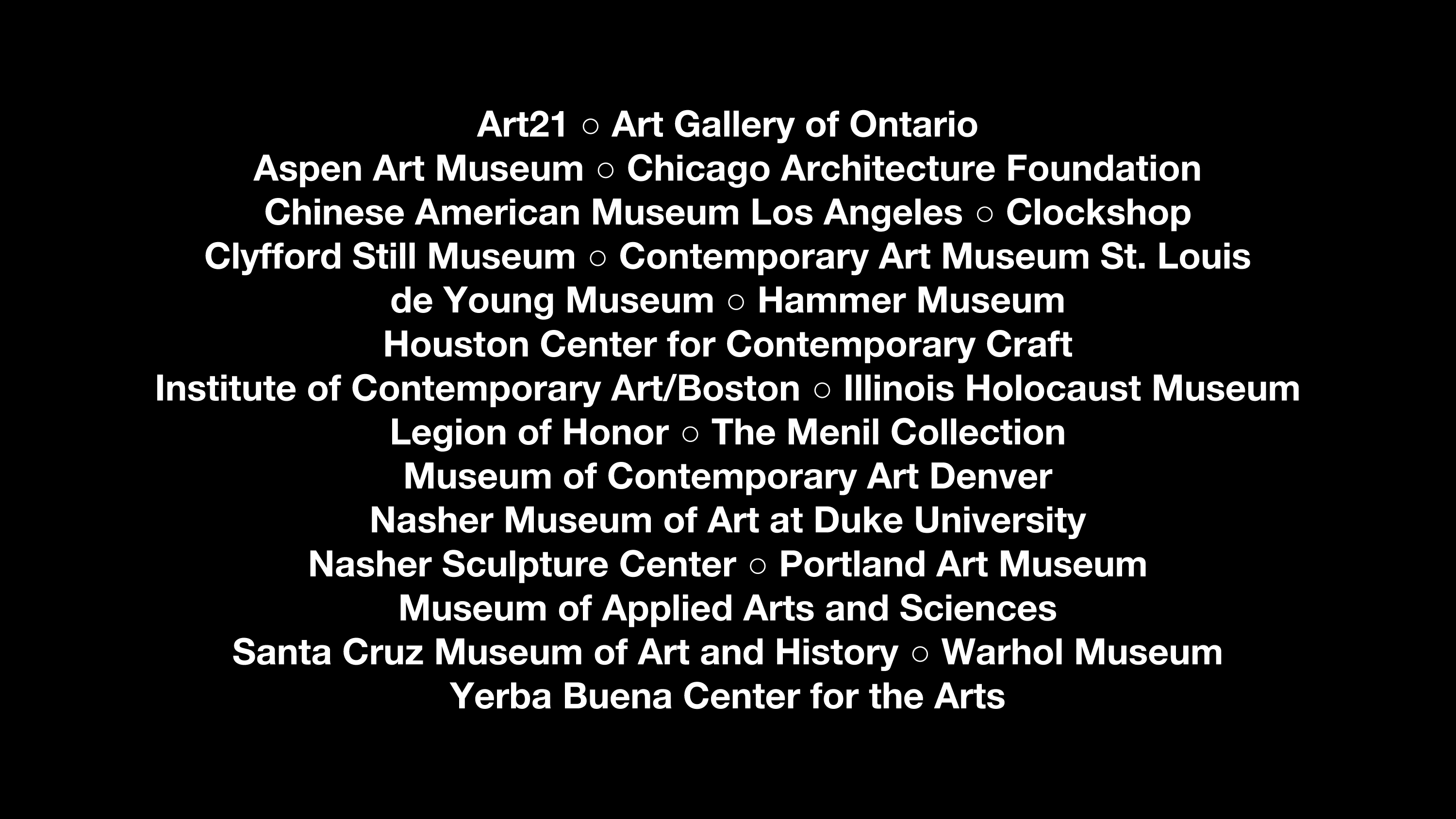
We are conducting a study with two dozen museums and cultural organizations across the country.
The project surveys the motivations of visitors to museum websites, based on the framework of visitor motivation developed by museum researcher John Falk. The quantitative data is collected through each institution’s Google Analytics account.
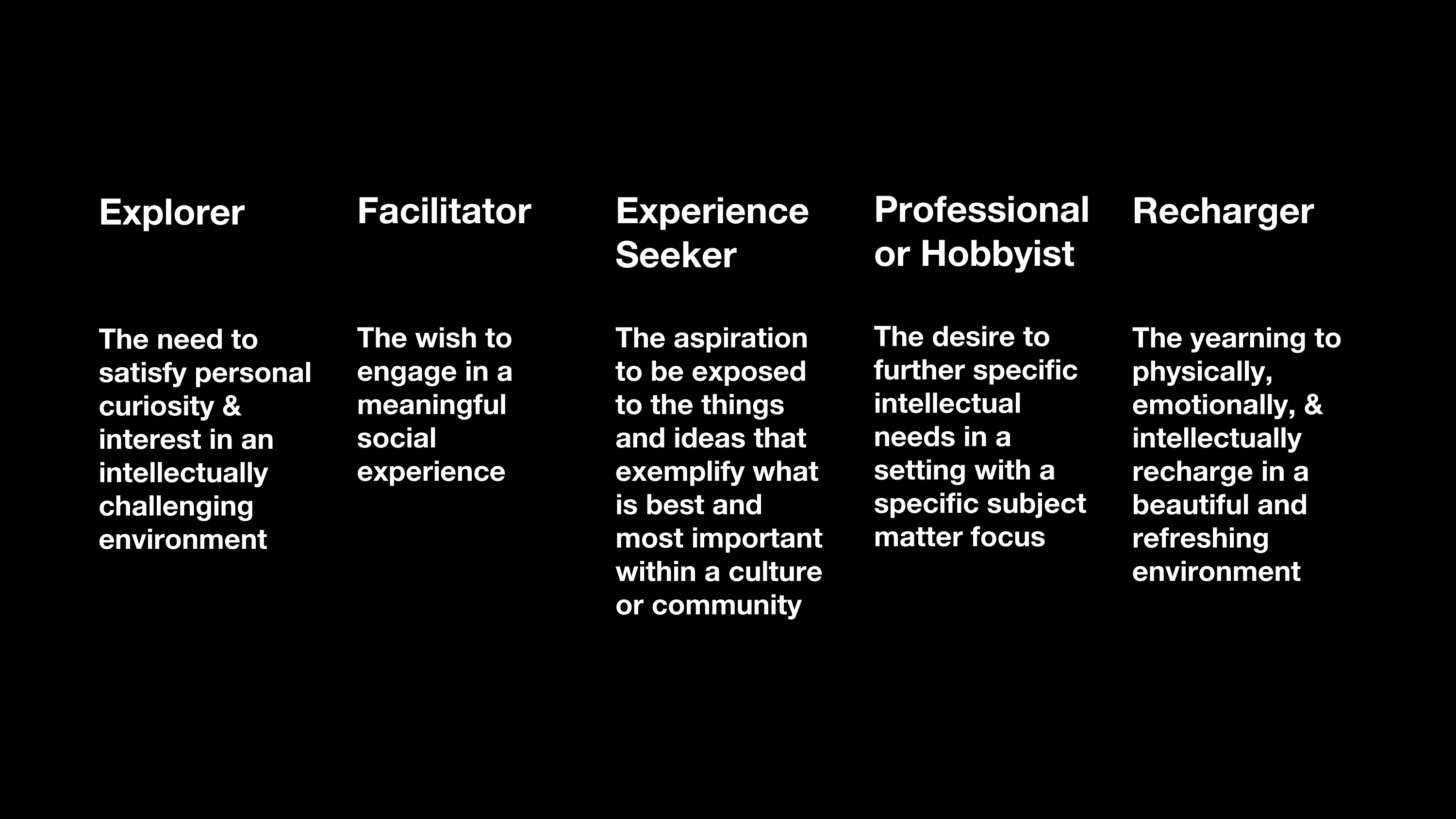
In his book Identity and the Museum Visitor Experience, Falk identifies five key types of visitors who attend museums and the internal motivations that drive repeat visitation. These motivations are Explorer, Facilitator, Experience Seeker; Professional/Hobbyist; Recharger.
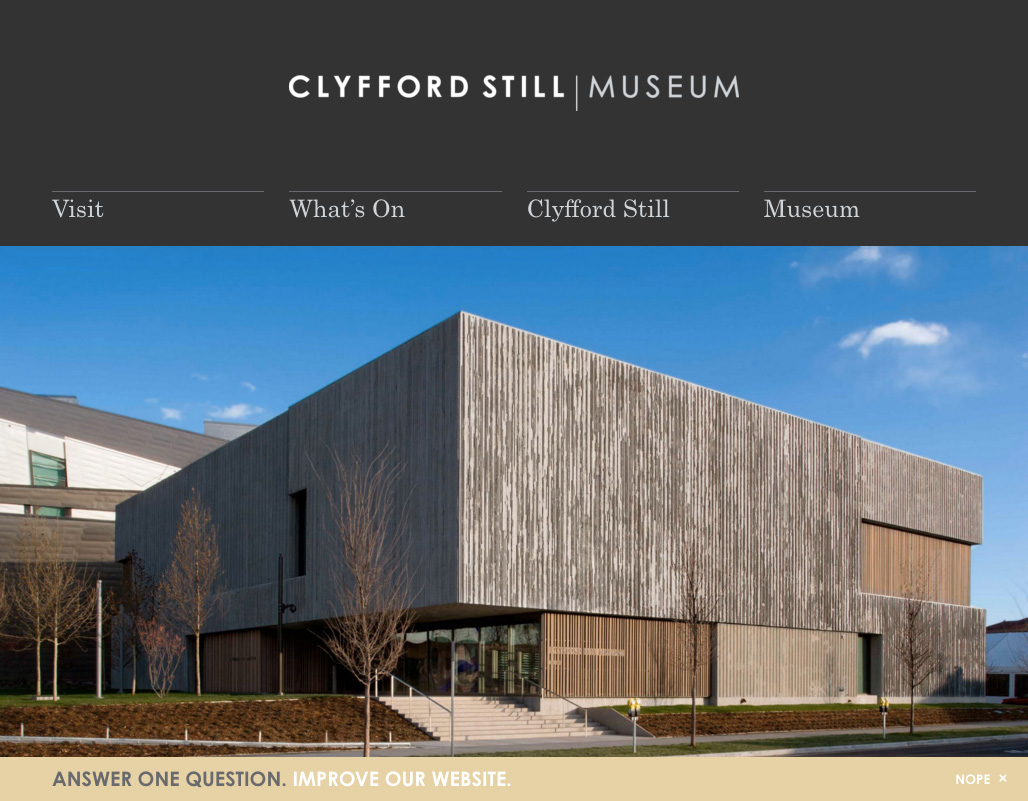
This is what the survey looks like. It appears on every page of the website, pinned to the bottom of the window. Users click it and it opens up.

The survey options are consistent across every institution. But the fonts and color are customized to match the individual site’s design.
The technical implementation is similar to the one used in a website visitor motivation survey by the Indianapolis Museum of Art. That survey was presented here at MW in 2012.
Here’s how it works. First, we configure the Google Analytics account with what’s called a “Custom Dimension.” We then install the VMS user interface on the site. This consists of snippets of HTML, CSS and JavaScript.
We have a version of the code packaged as a WordPress plugin, and a version packaged as a Drupal module. The underlying survey code can be adapted to any platform.
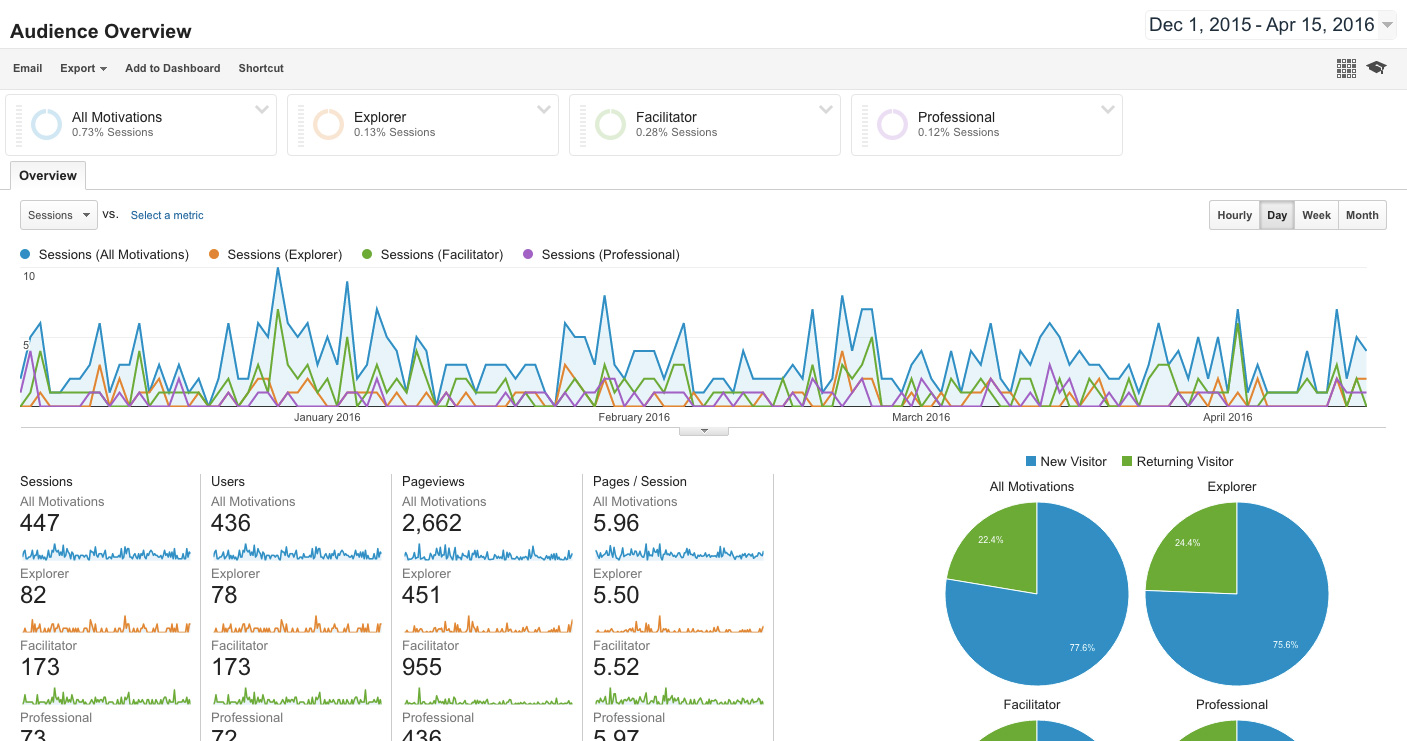
When the visitor chooses a motivation, it sets the Custom Dimension. This is a text string indicating their choice. And that’s the extent of the additional info we’re collecting. The rest is standard Google Analytics. The response is retained for the duration of the browsing session.
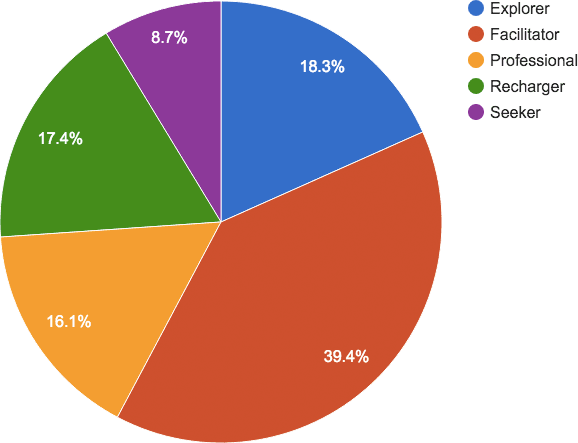
Participants are using the data to better understand how visitors are using their website and inform their work at their individual institutions. Here’s a report I ran for the Clyfford Still Museum.
This is website visitor sessions, broken down by motivation. The red area represents the “facilitators,” people who are planning a visit for a group.
One of the things that really resonated with me from Falk’s book is that most museums’ marketing is based on the exhibition schedule, but that most museum visitors have little if any prior knowledge of what’s on. This is particularly true of the Facilitators group, which prompted me to suggest to my institution that our next marketing campaign should be, “Look smart to your friends. Come to the Clyfford Still.”
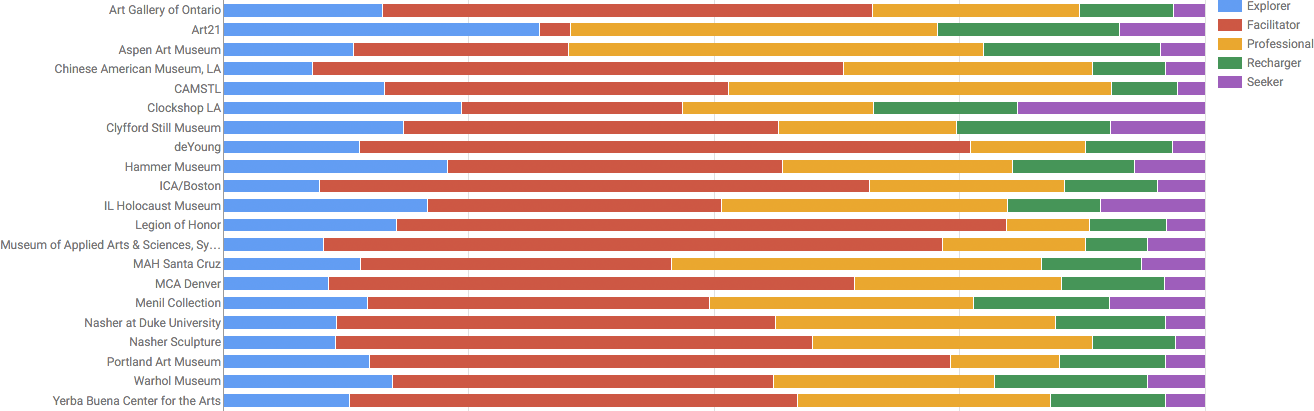
One of the other advantages of this study is the ability to compare data across institutions. Here’s that same “sessions by motivation,” but for all participants. This allows us to spot trends.
In this chart, the “facilitators” are, again, red. As you can see, there’s a fairly consistent breakdown of audience in this way, with Facilitators taking the largest slice of the pie.
But there are also some outliers, which raises interesting questions about what makes those websites unique and what conclusions we can draw from that. We’ve only just begun to unpack the data.
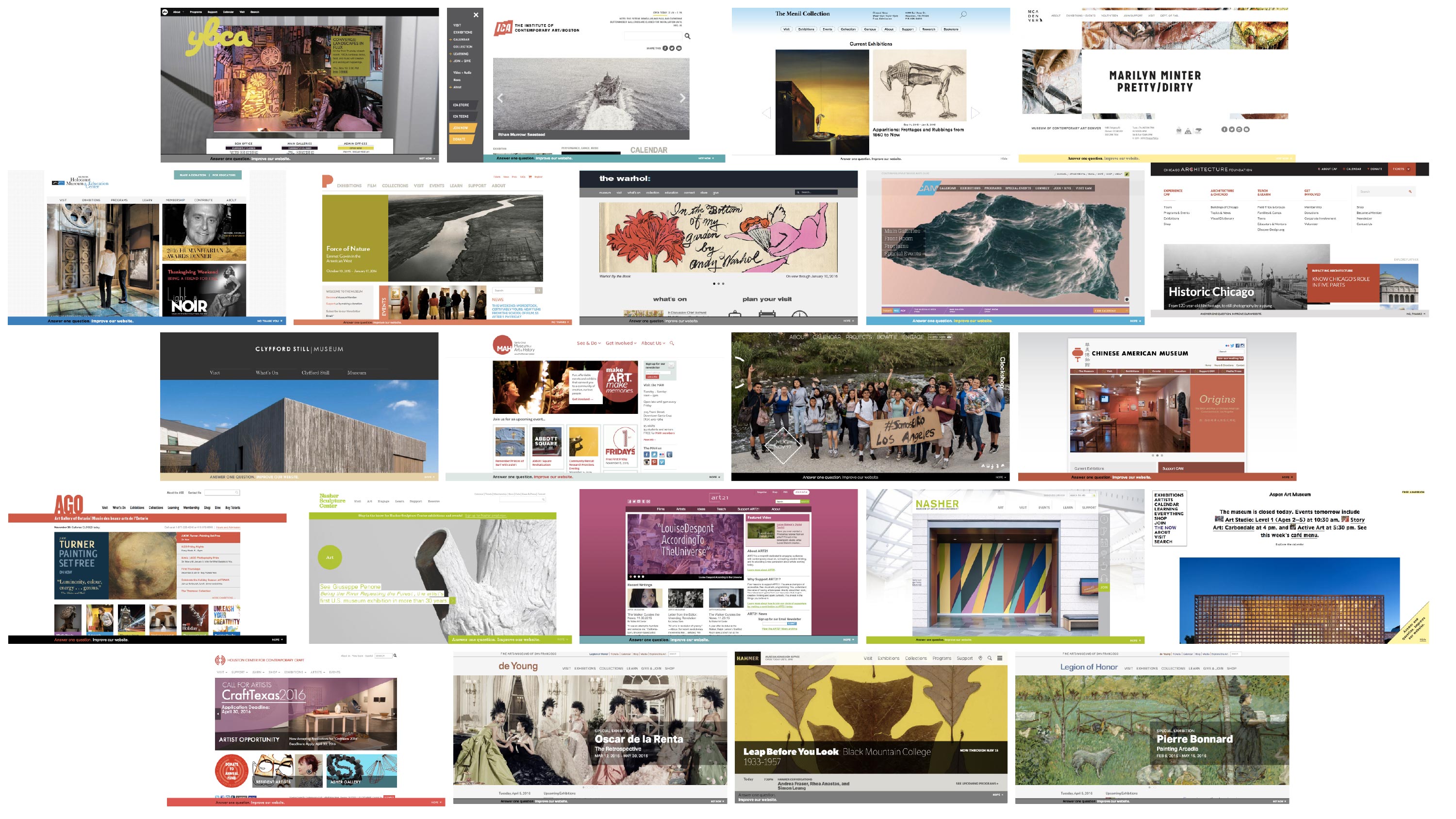
This is not just a research study, but a community of museums who are looking to better understand their online audiences.
In order to facilitate those conversations, we’ve started a forum on Slack. Professionals from each institution use this forum to ask questions and share knowledge.
We have threads dedicated to better understanding audience behavior; to website redesign projects; and to determining the benchmarks and trends that hold true across institutions.
A huge shout out to all the participants for this study. If you are from one of these institutions, please stand up. [Note: At this point our colleagues stood up and received a round of applause. ] If you’re interested in learning more about the study, please feel free to say “hi” to any of us.
Presentation at MCN 2016: National Museum Website Visitor Motivation Survey
a membership-based professional association that provides a space for museum professionals to connect, share resources and best practices, develop their careers, and advance digital transformation in museums. Hosted every year since 1968, MCN’s Annual Conference draws over 600 cultural heritage professionals from museums, historic sites and visitor attractions in North America and beyond. Each conference features a variety of interactions and professional development opportunities.
In 2016 the conference took place in New Orleans. I led a 60-Minute Professional Session that included Alli Burness (ThinkPlace), Susan Edwards (The Hammer Museum), Jacques Haba (Nasher Sculpture Center), Jonathan Munar (Art21), Tricia Robson (Fine Arts Museums of San Francisco), Sarah Wambold (Clyfford Still Museum) and Jessica Warchall (The Andy Warhol Museum).
The subject of our presentation was…
In 2015-16, cultural organizations across the United States, joined by partners in Canada and Australia, banded together to better understand museum website visitor motivation. This was not just a research study, but a community of museums looking to better understand their online audiences.
The survey comprised a single question about what motivated users in going to the website that day. Focussing on identity-related motivations (rather than demographics or behaviors), the survey responses aligned with museum researcher John Falk’s Predictive Model for Museum Visitation—Explorer, Facilitator, Professional/Hobbyist, Recharger, and Seeker.
Led by Sarah Wambold, Director of Digital Media at the Clyfford Still Museum, and Marty Spellerberg, of Spellerberg Associates, the project culls more than 16 weeks of data across 23 different museum websites. This is the first survey to utilize Falk’s framework online, the first focused primarily on small- and medium-sized organizations, and the first in the US to view the data in aggregate.
The study provided representatives from participating museums the opportunity to discuss their findings, highlighting patterns that emerged across the various institutions. In order to facilitate those exchanges, professionals from each institution have met online using Slack, asking questions and sharing knowledge. In this forum we will bring this dialogue to life and the voices of MCN attendees into the conversation.
Workshops for Artists, Filmmakers and Community & Art Organizations
I’ll be in Toronto presenting at LIFT and the Directors Guild of Canada this October. The first is focused on getting individual artists and filmmakers up-and-running online, with a website and social media accounts. The second is for professionals working with community and arts organizations, helping them focus their communication strategies for maximum relevance.
Workshop for Artists and Filmmakers:
Websites and Social Media
This workshop provides an overview of how to establish the online and social media presence for your film, company or personal brand as an artist or filmmaker. Learn how to set up the various platforms and effectively manage the accounts to build a community of engaged fans and supporters. Best practices, strategy and content creation for various tools will be discussed. Participants will learn to register a domain name and create a website, develop and send a professional email newsletter, and establish accounts and grow followings on social media platforms. Squarespace, WordPress, MailChimp, Facebook, Instagram, Twitter, Vimeo and Youtube platforms will be explored.
This workshop will be hands-on. Participants who come ready with specific projects/practices will be able to begin configuring accounts and creating webpages and social media posts during class time.
This workshop is being offered twice, at LIFT and at the Directors Guild of Canada.
For members of the Directors Guild of Canada:
Full-day workshop
Sunday, October 15, 10am-5pm
Registration required. Email [email protected]
For all others:
Two-evening workshop
Tuesday October 10 & Thursday October 12, 6-10pm
Registration required. Call 416.588.6444
Workshop for Community and Arts Organizations:
Understanding Online Audiences
This workshop is for staff at community organizations and arts organizations who wish to effectively communicate and connect with their online audiences. Your audience does not see your organization as you do. When you structure your messaging in a way that reflects the perspective of those inside your organization, you miscommunicate your relevance to those on the outside. Members of your audience are driven by intrinsic motivations and are drawn to your programs to the extent that they address these internally-driven needs. This workshop will help participants identify and speak to the motivations of their online audiences.
For all participants:
One-evening workshop
Wednesday October 11, 6-10pm
Registration required. Call 416.588.6444
Presentations at WordCamp DC & WordCamp Austin, 2017
In 2017 I presented at two WordCamps: DC with Desi González, and Austin with Zack Rothauser.

Here’s how we described the DC talk:
In May 2017, The Andy Warhol Museum in Pittsburgh, PA rolled out a redesigned website, built on on WordPress. In addition to taking advantage of an easy-to-use content management system and a strong open-source community, the move to WordPress opened opportunities to solve perennial museum website problems.
We will discuss the development of the website’s content strategy and design, informed by analytics and qualitative user research. We will demonstrate the ways we built the new site to solve specific museum and user needs, including designing a system of flexible page templates, solving event calendar challenges, and implementing systems/workflows for managing intellectual property restrictions for collection images.
And here’s how we described Austin:
This talk will present a look under the hood of some WordPress-powered museum projects. We’ll explore WordPress as a solution to a variety of common problems, including powering websites, digital publications and in-gallery experiences. Our lens will be recent projects for the The Andy Warhol Museum, Pittsburgh; The Clyfford Still Museum, Denver; The Santa Cruz Museum of Art and History and others.
In addition to taking advantage of an easy-to-use content management system and a strong open-source community, WordPress opens up opportunities to solve perennial museum website problems. We will discuss the development of museum websites’ content strategy and design, informed by analytics and qualitative user research. Additionally, we will demonstrate the ways we’ve solved specific museum and user needs, including designing a system of flexible page templates, solving event calendar challenges, and implementing systems/workflows for managing intellectual property restrictions for collection images. We will also explore how WordPress can be used to power experiences outside of traditional websites, including membership renewal and constituent management, online exhibition catalogues and touchscreen video kiosks.
Understanding Online Museum Audiences: Academic Research on Digital Visitor Motivations

Circa 2016, we co-led a study into the motivations of museum website visitors, with 23 institutions participating. We presented this work through several conference presentations and in an article in the Journal of Digital & Social Media Marketing.
For an overview of the project, see our post about the MW 2016 presentation. To watch various study participants present on their findings, see the video of the MCN 2016 presentation.
The Journal of Digital & Social Media Marketing is
the major peer-reviewed, professional journal for all those involved in the marketing of products or services using digital channels. Its overriding goal is to provide an authoritative, practitioner-focused forum to support the professional development of all those working in, or entering, the field. As such, the Journal’s content is both of direct relevance to the practice of digital marketing and intellectually rigorous.
Volume 5 Number 4 (Spring 2018) includes the piece, Identity-related motivations online: Falk’s framework applied to US museum websites by Sarah Wambold and me. Our piece presents the results of our VMS project.
The abstract:
In his book ‘Identity and the Museum Visitor Experience’, John Falk examines the visitor experience as it relates to what he terms ‘identity-related motivations’: a series of specific reasons used by visitors when choosing to attend a museum, based on their particular needs and values. Through thousands of interviews with museum visitors, Falk identifies five key types of museum visitor and the internal motivations that drive repeat visitation as: experience seeker; explorer; facilitator; recharger; and hobbyist/professional. This study utilises Falk’s framework in an online survey of 23 museum websites. This is the first survey to utilise Falk’s framework online, the first focused primarily on small- and medium-sized organisations, and the first US-based study to view the data in aggregate. This article presents high-level results from the survey, as well as an in-depth look at online audiences for one museum from the project.
Journal reprints available
We have a limited number of article reprints available for colleagues and scholars. If you would be interested having one mailed to you, please reach out to us by filling out the following form.
Presentations at MCN 2018

a membership-based professional association that provides a space for museum professionals to connect, share resources and best practices, develop their careers, and advance digital transformation in museums. Hosted every year since 1968, MCN’s Annual Conference draws over 600 cultural heritage professionals from museums, historic sites and visitor attractions in North America and beyond. Each conference features a variety of interactions and professional development opportunities.
This year the conference is taking place in Denver, and I’m involved in three presentations.
Proud to be Flesh: Cultural Spaces After the Internet (A conversation between museum technologists and local artists)
Exchange big ideas on complex topics with local artists and practitioners at this conversation-in-the-round about the impact of the Internet on cultural spaces. Now that a generation has grown up not knowing a world without the Internet, has the question evolved from “Do cultural institutions need to be online?” to “Do cultural institutions need to have physical spaces?” Consider the work of artists such as Yayoi Kusama and Kara Walker, whose work was so prolific on Instagram, Art In America reported that even arts professionals “willfully refrained from seeing [the work] … because they felt that they had already sufficiently experienced the piece.”
This unmoderated exchange, facilitated by local arts organization Tilt West, will explore the nature and relevance of digitally-influenced physical spaces, providing a rare opportunity for heady dialogue and a chance to experience a slice of the Denver art scene. Participants will journey offsite to a lesser-known art space to exchange ideas, evolve perspectives, and make connections across disciplines.
Understanding our audiences: The Whitney’s Website Visitor Survey and its broader context
This session will share learnings from the Whitney’s recent website visitor motivation survey, and review how these resonate with the recent Museum VMS paper published in the Journal of Digital and Social Media Marketing. We will cover methodological approaches and findings, as well as the usage of motivation as a key variable to define website segmentation. The Whitney’s results will be reviewed in the context of ongoing efforts to understand the intersectionality of museum audiences, and the development of human-first approaches, blending an understanding of user intent and action to measure more meaningful behavior and engagement.
Drawing on case studies from the Met and the Tate, we’ll look at how these studies influence decisions in the digital roadmap of these institutions.The ongoing exploration of visitor motivation and the public sharing of the results at conferences and in peer-reviewed journals represents an important dialogue that is stimulating the evolution of websites and digital content. By demonstrating how museums gain insights into audience motivations and behaviors, the session endeavors to spur more museums to conduct VMS projects. The audience will learn how to implement VMS projects at their own institutions, how to analyze the results, and make use of the data.
Emotion, Intimacy and Space: Designing and Developing the Clyfford Still Museum’s In-Gallery Video Kiosk System
This case-study session will present insight into how digital design can reflect the physical space in which it is installed, how graphic and movement choices affect visitors’ sense of intimacy, and how the interactive components of museum visitors’ experience can be made approachable through the collaborating disciplines of design and development. The Clyfford Still Museum’s in-gallery kiosk system acts as an interactive library that makes accessible to visitors the full archive of videos commissioned by the museum, with every aspect of the design having been considered in terms of user experience.
We will demonstrate how a content-management back-end allows the visitor-facing presentation to scale with the museum, and how this can be achieved while fitting into a museum’s established technology stack. We will cover how advanced features of WordPress, including the REST and Caching APIs, can be used to power a React-based front-end.
Presentation at WordCamp NYC 2018
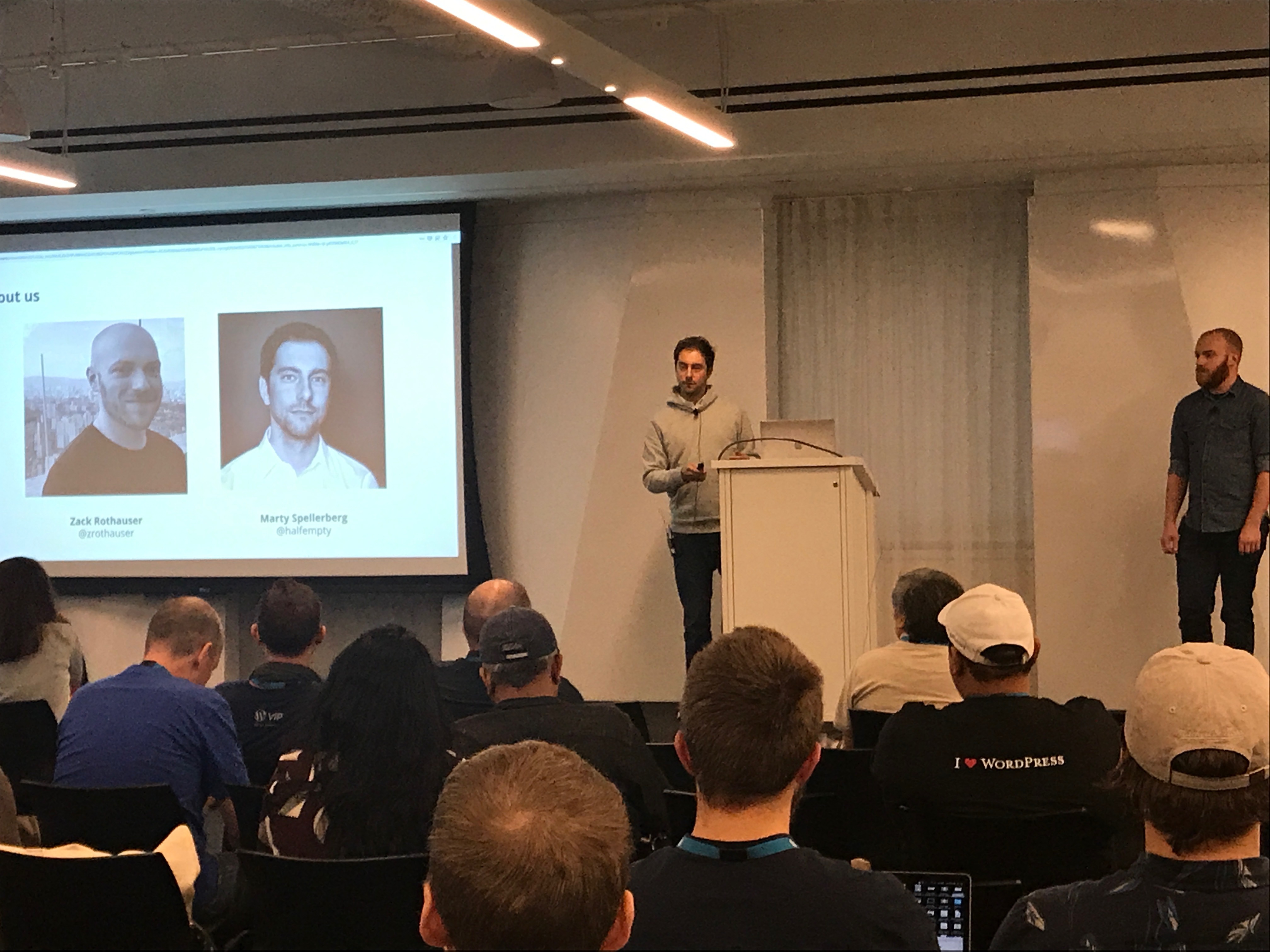
Zack Rothauser and I will be heading to WordCamp NYC 2018 to give a presentation on the Clyfford Still Museum’s web-based touchscreen video platform.
Since the introduction of the WordPress REST API, the potential for using it to power React applications has generated much excitement among developers. But what is an actual use-case for these technologies, and how can it improve the user experience? In this presentation we’ll show how WordPress was used as a foundation for building an in-gallery video kiosk for the Clyfford Still Museum.
We’ll begin by looking at the design process for a museum experience: How digital design can reflect the physical space in which it is installed, and how graphic and movement choices affect visitors’ sense of intimacy. We’ll show how the video kiosk platform was built to scale with the museum’s growing video library, how we made the videos accessible to people with hearing impairments, and how we designed the system to be content-managed from afar.
From there, we’ll demonstrate how content-management via WordPress combined with the REST API and a React front-end provide an intuitive experience for administrators and users, save development time, and provide a smooth native-app-like experience. We’ll finish by detailing the hardware used to present the system in-gallery.
We’d like to thank WP Engine for supporting this presentation.
Call for Participants: Museum Digital COVID-19 Research Study
We are living through history. Around the world, the COVID-19 pandemic is reshaping society. When Americans began practicing “social distancing” and following orders to shelter-in-place, museums and cultural organizations moved quickly to cease public visitation. But even as our institutions closed their physical doors, we have opened digital windows. We have adopted online tools to continue delivering on our missions, serving our communities, and engaging our audiences.
To document the beginning of this new chapter, professionals from across the sector have begun collaborating on a cross-institutional study. The working title of this research is “Effects of COVID-19 on the social and digital media of American Museums.” The objectives are to create a record of this moment to inform planning for future emergencies, and document emerging practices.
This research will collect and aggregate metrics from standard digital reporting tools, then report on the trends uncovered. We will examine a variety of interactions such as web traffic, searches, video views, downloads of learning resources and kids content, virtual tour visits, and social media sentiment. This project follows a previous cross-institutional study on the motivations of museum website visitors
Right now, we are building the cohort. We seek cultural institutions of all sizes, with collaborators of varied job titles across digital, social, education, curatorial, and marketing. While our focus will primarily be on US-based organizations, international organizations are welcome to contribute.
Please join us. Express your interest in this research via the sign-up form.
Museum Digital COVID-19 Research at MCN 2020 Virtual Conference
Since COVID-19 first hit, I have been conducting a cross-institutional research study about the effects of shelter-in-place on museum website visitation. Researcher Grace Poole and I have been working hard over the past several months to analyze the pandemic’s impact across the sector’s digital activity.
Findings Presentation at MCN 2020 Virtual Conference
We will be presenting findings at the MCN 2020 virtual conference on Tuesday, November 17th, at 2:00 pm EST. Tim Hart from the J. Paul Getty Trust and Colin Brooks from the Whitney Museum of American Art will join us to discuss the effects of lockdown on their institutions. Here’s a taste:

This graph, with data from 20 institutions, shows the year-over-year change to museums’ website visitation. We will be revealing additional, previously unseen findings in our presentation. And we are looking forward to answering audience questions.
Platform Ethics Presentation
Conference-goers should also catch “Digital Platforms Are Not Neutral.” In this roundtable, Dana Allen-Greil, Eric Longo, Nikhil Trivedi, Matt Popke, Sarah Wambold, and I will consider institutions’ responsibility when selecting digital platforms.
Conference tickets are still available. I hope to see you there!