Research
Museum Website Top-Level Navigation Items
How many navigation items do museum websites have? How are they split? What are the most common terms? I looked at 35 museum websites and this is what I learned:
60% of sites split their persistent navigation into two groups (usually with different font sizes or visual treatment). In this case, the average number of buttons is 13, with 8 in one group and 5 in another.
For the 40% of sites presenting all their top-level items in one group the average number of buttons is 9.
The average number of buttons overall is 11.5.
The most common terms are as follows:
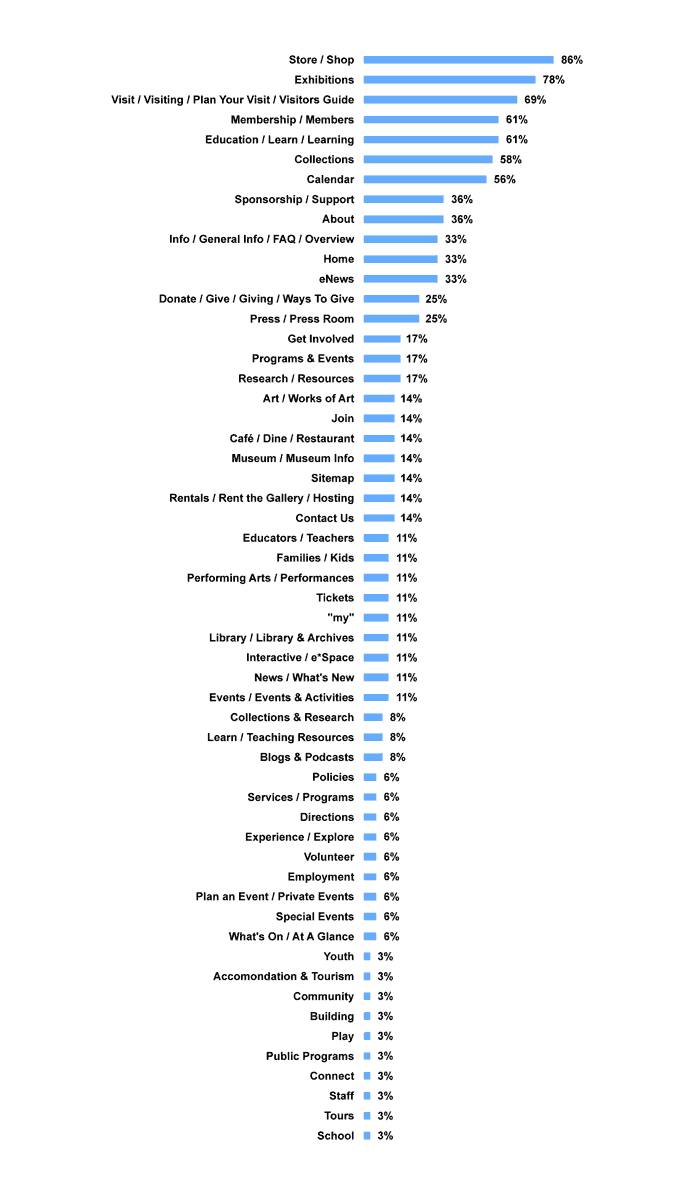
This research was conducted in March 2008 at the Art Gallery of Ontario. The 35 sites surveyed were: Glenbow, Skirball, Vancouver, Sfmoma, San Jose, LA MOCA, Phoenix, Colorado, Carter, Houston, New Orleans, Norton, High, Chrysler, Cincinnati, Indianapolis, Wexner, Baltimore, Chicago, Milwaukee, Albright-Knox, Montreal, Guggenheim, Brooklyn, Quebec, MoMA, Tate, Louvre, National Canada, ROM, Philidelphia, Detroit, Met, Chicago, National USA.
Museum Information Architecture: Where Are Weddings?
Weddings and other private events are a major source of revenue for museums; I’ve heard it said they “keep the lights on.” But where on a museum’s website will you find information on this service?
We grappled with this question in 2008 at the Art Gallery of Ontario as part of an information architecture review. From the museum’s perspective it’s an important business — does that mean it warrants a “tab” in the top level navigation? Some museums have it there. But on the other hand, it’s irrelevant to the vast majority of the site’s users, who are looking for current exhibits and the hours of operation. Also, how is it referred to? “Special Events” seems common in the event industry, but it conflicts with other museum initiatives such as fund raising galas. “Private” indicates exclusivity.
Here’s what I found in a survey of 50 museum websites:
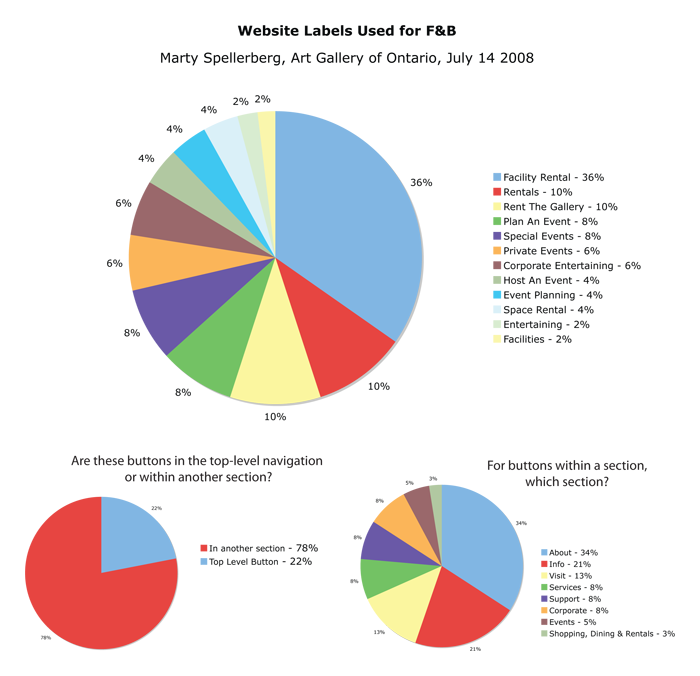
“Facility Rental” came out as the clear winner, with 36%. While 22% made it a top-level priority, the majority put it within another section. Which section? “About” with 34%, or “Info” with 21%.
At the AGO we used these findings to inform the decision to call our section “Venue Rental” (which sounds nicer while still avoiding conflict) and link it under “About.”
The sites surveyed were: Skirball, Vancouver, Sfmoma, San Jose, LA MOCA, Phoenix, Colorado, New Orleans, Norton, High, Chrysler, Cincinnati, Indianapolis, Wexner, Baltimore, Chicago, Milwaukee, Albright-Knox, Guggenheim, Brooklyn, MoMA, Tate, Louvre, Canada, ROM, Philadelphia, Detroit, Met, Chicago, Bata, Kansas City, New Museum, Walker, Calgary, Kamloops, Nanaimo, Two Rivers, Victoria, Fredericton, Hamilton, McMichael, Nova Scotia, Mendel, MacKenzie, Anchorage, Birmingham, Boise, LA County, de Young, New Brit.
Museums, Collections and Art
This is the first part of my notes on Museums By Artists, edited by A. A. Bronson & Peggy Gale and published by Art Metropole in 1983. Phrases have been lifted from the text, then grouped with like. See also: Collecting as an Artistic Mode.

Daniel Buren
Museums by Artists (Poster), 1983
Art Metropole Toronto Canada
56.6 x 78.5 x cm.
The museum has history, volume, physical presence, and cultural weight. Its function is aesthetic, economic and mystical.(1) No museum is able merely to exhibit contemporary art.(2)
Both “public” and “private” institutions are political.(3) The museum is a power symbol,(4) and carries social and political connotations.(3) It has become a necessary symbol of the city and the culture of the city. It is a symbol of the culture of the new rich, dignifying the power, status and tastes of the central Government and financiers.(2) These are the employers who set the boundaries for decisions made by museum officials and “some museums do not think they have sufficient independence to exhibit a portrait of their own structure.”(3)
Museums convert the aesthetic construct into an object of contemplation, transforming the primary language of art into the secondary language of culture and disseminating the abstracted meaning(5). Primarily framing devices for the urge to collect,(4) museums select, acquire and protect work, sheltering it from questioning. Museums “act as a refuge, without which no work can exist.”(1)
A museum’s collection is a “whole,” forming a context having various foci. Works are brought together based on associability (period, quality, form, culture), producing a harmonization of some aspects but exhausting others.(6) The result is a simplification of a work’s historical and psychological weight.(1)
In social/group exhibitions, varied / un-alike artists are shown together. This serves to compare the otherwise incomparable, lending impact to the chosen works and resulting in the “warped” discourse that creates opposing schools and movements. In contrast, single-artist exhibitions have a flattening effect, stressing the differences within a single body of work. There is an economic insistence on “miraculous, successful” works versus those that have “failed,” as the former boost the sales value of latter, through association.(1)
“A museum is the collection of an institution and it’s an anthology. A few anthologies are all right, but some hundred in the United States alone is ridiculous. It’s freshmen English forever and never no more no literature.”(2)
The place of showing marks and imprints the work.(1) In this context, art elevates awareness of its specific social situation and function to the status of “theme”.(7) The “history still to be made” is integral to this work; art only exists in, and is destined for, a museum. The museum becomes the single the cultural-visual viewpoint from which a work can be considered. “Everything the museum shows is only considered and produced in view of being set in it.”(1)
A collection is an excuse for the building housing it. More money is spent on architecture in the name of art than on the art itself.(2) “What is a museum without clearly defined rooms? An enormous burden for art.” The ideal presentation is one which allows the eye to perceive the works’ readiness to participate.(6) But surprisingly, no special attention is paid to this place.(1)
The institutional architectural language is characterized by the false neutrality of white walls and false timelessness and immobility of placement.(5) Art is treated as eternal, obviating temporality.(1) Works are preserved from decay(5) and shown for a long time in unchanging environments, causing them to lose their suddenness, their unique element of surprise.(6) Extracted from any original context and function,(5) works appear to have fallen from heaven, detached, as if created by the museum itself.(6) (This is considered natural but is only historical, our present day ideas of preservation having been inherited from 19th century.(1))
This fate rarely corresponds with artist’s production intentions.(7) Living artists do not want to be embedded in the collection; they prefer to rise above them as a “dramatic voice related to their era.”(6)
Works of art are acts of decision, choice and self determination which undergo a material transformation through social interaction. The nature of this transformation belongs to the discourse surrounding them. This discourse takes place within the social institutions and historical circumstance that constitute the conditions of the work’s reception. The concerns artists choose to integrate within the conception of a work originate from anticipation of these conditions, its final distribution and institutional modes of reading.(5)
A “Fluxus Definition of Art” uses three stages of filters: Artificial, Non-Functional and Cultural. The Artificial begins by excluding all that is not human creation; the Non-functional (leisure) then excludes all which is essential to survival or to material progress; and, finally, the Cultural excludes all witch is without pretense to significance, profundity, seriousness, greatness, inspiration, elevation of mind, institutional value, exclusiveness. This leaves us with the Fine arts only: the literary, plastic, musical and kinetic.(8)
“In the work’s attempt to dissolve reification within the very medium and the site where they are produced, in the necessity to mimetically anticipate its subjection to ideology by inscribing itself as precisely as possible into those very systems that determine its historical status, it seem to fail to maintain any claim for autonomy and rupture in favor of a complacent, melancholic and passive contingency upon the conditions of rule that it set out to disrupt.”(5)
“Products which are considered ‘works of art’ have been singled out as culturally significant objects by those who at any given time and social stratum wield the power to confer the predicate ‘work of art’ unto them; they can not elevate themselves from the host of man-made objects simply on the basis of some inherent quality.”(3)
See also: Collecting as an Artistic Mode.
References
All from Museums by Artists, A. A. Bronson, Peggy Gale Editors, ISBN 0920956130.
- Daniel Buren. Function of the Museum / Function of the Studio / Function of Architecture: Notes on Work in Connection With the Places Where It Is Installed
- Donald Judd. On Installation
- Hans Haacke. All the Art That’s Fit to Show
- AA Bronson. The Humiliation of the Bureaucrat: Artist-Run Centers As Museums by Artists
- Benjamin Buchloh. The Museum Fictions of Marcel Broodthaers
- Jean-Christophe Ammann. A Few Modest Thoughts on the Prerequisites for Museums and Exhibits of Art, in Particular of Contemporary Art, and for Visitors to Such Museums and Exhibits
- Walter Grasskamp. Artists and Other Collectors
- George Maciunas. Fluxus (Its Historical Development and Relationship to Avant-Garde Movements)
Thank you Kathleen McLean.
Collecting as an Artistic Mode
This is the second part of my notes on Museums By Artists, edited by A. A. Bronson & Peggy Gale and published by Art Metropole in 1983. Phrases have been lifted from the text, then grouped with like. See also: Museums, Collections and Art.
Daniel Buren
Museums by Artists (Poster), 1983
Art Metropole Toronto Canada
56.6 x 78.5 x cm.
Collecting as an artistic mode has taken various forms throughout history. Early expressions include the collection of studio props and the assembling of the products of colleagues. Depictions of art collections are later joined by “collection pictures,” consisting of numerous small images.(1)
Cubists Braque and Picasso incorporated fragments from “reality” such as stenciled characters and facsimile materials into their pictures without the application of pictorial distortion.(2) This emergence of assemblage and collage signaled a reevaluation of collecting, but still within traditional media.(1)
Marcel Duchamp went further, declaring found objects themselves to be works of art and signing them.(2) Flowing from his self-definition as a flaneur who selects objects for ready-mades, he reduced the visibility of his paintings in favor of emphasis on material elements. In doing so he revealed the obsolesce both of Surrealism’s pictorial production and the retrospective exhibition format, anticipating “the ultimate destination of the object into the structural definition of the work.” Through his concern with placement, transport, evaluation, institutionalization, display and maintenance, Duchamp changed role of the artist as creator into that of collector and conservator.(3)
From its inception with works on canvas, the activity of isolation and reorganization of objects had grown in scale until it lay claim to largest possible setting for presentation, an evolution which lead to the employment of the organizational pattern of collecting — the “Artist’s Museum.” (1) In the hands of artists, a Museum could be used to clarify, heighten or counterpoint intent, or as the actual content or medium of production.(4) Even regarding indirect collections, such as the creation of an exhibit of a collection made or left over by another,(1) what mattered was not the origin of the collection but how, as found or transformed, it fit into the artist’s autonomous form or idea.(2)
“These are museums by artists. And what better place to develop the interior kingdom of the soul than in … this idealized vision of the ‘museum,’ of history, in which the artist animates the quaking body of the institution with his own obsessive will?”(4)
But to create ones own museum was simply to create a “little picture” on another scale. Artists found more success when they matched an object and place which dialectically implied each other. Such artists showed what a work implied in a given place, leading to a consideration of what the place itself implied. Work produced for the Museum must examine its influence. Or, going further, it’s impossible to conceive a work outside the place where it will be exhibited. And it follows that “work taking into consideration the place in which it is shown cannot be moved elsewhere and will have to disappear at the end of the exhibition.”
This, however, presented a challenge to the Museum’s inclination towards preservation and the narrative of “immortality” it desired to present.(5) And so in the 1960s and 70s, language-based art began to question the roles of institutions such as the museum, dealer, collector and public; rejecting object-centered assumptions of construction and sale, and the requirements of exhibition, collection and power hierarchy.(6)
In June and July of 1969, Iain and Ingrid Baxter of N.E. Thing Co. created an environment at the National Gallery of Canada, Ottawa. This performance was “a parable about gallery space” in which a national gallery was turned into an artistic venture commenting on its context. Reflecting “the building’s intended existence as an office complex,” they took over the first floor of the gallery to assemble the Company’s premises and products, with Iain Baxter going to the office every day to carry out the normal “business activities” of his art practice.(7)
The Documenta 5 exhibition of 1975 was “gesantkunstwerk,” using artists and works as if they were “dabs of paint in the panting.”(8) The expanse of collection was emancipated from subservience to artistic production, having become a form of production in its own right. “The collection as manifest outcome of artistic activity thus came to lay claim to the institutional setting which hitherto had been reserved for artist’s products.”(1)
The ultimate example may be bureaucracy as a museum by artists, as embodied by Canada’s Association of National Non-Profit Artists Centres (ANNPAC). Founded in 1976, the Association was a living museum resulting from the self determination of artist run spaces and lack of a viable art market or access to New York’s hype-system. It existed in an aura of hyper-aesthetic tension between idealism & poetic aspiration and the empirical realities of cash. Defined by democratic meetings and the lowest common denominator mechanisms of bureaucracy, artists participated in the nationally funded cultural character. (This is in contrast to the US, where they crumble under the entrepreneurial model.)
ANNPAC, a structure for the union of museums by artists, existed outside any particular physicalities. The continual, casual travel for exhibitions, performances and lectures was enabled by communications technology and the Canada Council’s program of travel grants, with publications and video serving as additional connective tissues. Intrinsically self-defining, they allowed communities of artists to recognize themselves as existing (for “we all know the importance of seeing ourselves”). The artist in this context inhabits flux of dream galleries, enacting the whole chain of art world beings.(4)
“The museum in the head is the place, the world, where a never static sum of speculations feed from diverse sources struggle for visualization.”(8)
See also: Museums, Collections and Art.
References
All from Museums by Artists, A. A. Bronson, Peggy Gale Editors, ISBN 0920956130.
- Walter Grasskamp. Artists and Other Collectors
- Claes Oldenburg. Mouse Museum
- Benjamin Buchloh. The Museum Fictions of Marcel Broodthaers
- AA Bronson. The Humiliation of the Bureaucrat: Artist-Run Centers As Museums by Artists
- Daniel Buren. Function of the Museum / Function of the Studio / Function of Architecture: Notes on Work in Connection With the Places Where It Is Installed
- Peggy Gale. Introduction
- N.E. Thing Co. Ltd.
- Harald Szeemann. Museum of Obsessions
Thank you Kathleen McLean.
Harald Szeemann and Daniel Buren in Documenta 5
Following my notes on Museums By Artists, I was interested to hear more from Daniel Buren on Harald Szeemann and Documenta 5. Luckily, filmmaker Jef Cornelis recently issued an archive of footage from that exhibition, including interviews with the two men. I have transcribed their comments here, including Buren’s clear articulation of his thesis.
Harald Szeemann
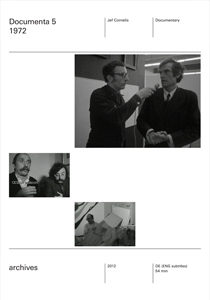
DVD cover of Jef Cornelis’ film Documenta 5 (1972)
We planned this “documenta Urbana” which was, in a way, Mr. Bode’s dream. We also had the documenta seminar, which was Mr. Brock’s dream. But neither one can guarantee documenta’s status as an event, which is the only thing that will bring people to Kassel. And this town really needs visitors during the documenta.
After a certain period of reflection, there was only one possibility which would once again bring a quarter of a million visitors here: by making the most of the prestigious status art possesses in the world, but in order to say something different.
… documenta 5, for many people, it’s been a stabilising force. Various artists, who see themselves as subversive, see no alternative than to remain in the museum context, which is the only context giving meaning to their work.
Q: But it was still you who —
It would be ridiculous to deny it. And I think, from the start, I asked, I demanded that I have that power. I insisted that they replace the committee and give me total responsibility for this exhibition. Otherwise I couldn’t do it.
… It’s clear that a seminar would have been the purest form, and most suited to the situation in 1970. So no visitors. Naturally, we’ve tried in these two years to retain that thematic aspect, to break away from the notion of a modern art exhibition. But at the same time, we couldn’t just ignore the original idea, to make it an event, to draw attention, for the same ten per cent of the visitors, to the didactic aspect of the exhibition.
Daniel Buren
(I’m) displaying my work, the paintings, in this unusual place, in different sections, all throughout the articulation of the exhibition, between the two museums which constitute documenta.
Q: Only inside?
Only inside, yes. Because I think this exhibition, the way it’s divided into sections, moving from one section to another is like going from inside to outside, but within the overall whole that is the exhibition. From one section to another, you go from the inside to the outside.
Q: Have other artists agreed to use your work as a backdrop?
I should say that I wouldn’t have asked.
Q: But there weren’t any problems?
Not so far.
Q: Is it modesty or… Why did you choose such neutral colours?
The colors I chose are theoretical and technical at the same time. In order to bring this idea to fruition, the work had to have absolutely no visual importance, no real importance. So I had to choose something very neutral, very soft. The only way to achieve that restrained tonality was to choose white on white, which poses other problems.
Q: Do you think the public will be suspicious of that?
It doesn’t matter.
… The demonstration is parallel to the demonstration by the curator, Szeeman. The work sort of becomes part of the museum, in which we have come and hang our artworks. Or installations or performances, etc.
Q: So you’re saying Szeeman has himself created a big artwork?
Documenta is characteristic, in a way. As are almost all exhibitions. But it’s very visible here. Harald Szeeman is the artist who has created this enormous painting, which happens to be the exhibition itself. So the exhibition is an exhibition of an exhibition.
… To my surprise, all the artists here are prepared to be put in boxes.
Q: What boxes?
Each room is a box. And you have a label, a title, you’re classified. And we each install ourselves to fit the box.
… We still haven’t emerged from the 19th century. We’re still in the world of pictures. Art is still a series of pictures. Be they conceptual or hyperrralist. We each hang up our picture, which is sort of the meaning that I’m trying to convey, inasmuch as we’re hanging a picture on something. The picture is just there in its own right.
Q: And that’s a 19th century notion?
I think it’s 19th century, it’s also 20th century, which is nearing its end. Although we’ve all been pondering this problem for nearly a century, it still hasn’t been dealt with. It’s still all about pictures and metaphors. It’s interesting and questionable that metaphors exist here, in the idea of a museum exhibiting a museum.
Understanding Museum Website Visitor Motivation using Google Analytics
This post is a collaboration between Sarah Wambold and Marty Spellerberg. Sarah Wambold is a Denver-based project manager and documentary producer. Marty Spellerberg is an Austin-based interactive media developer.
Google Analytics is a powerful tool for understanding traffic to a website. The standard site statistics, however, don’t always tell the full story.
For instance, interpreting the duration of an average site visit is highly speculative. It is typically thought that the longer a visitor spends on the site the better, and that shorter interactions are less successful. But this is not necessarily the case.
Take a visitor who comes to the site looking for the museum’s hours. If she was able to quickly and efficiently locate the information she needed, this interaction should be considered positive, despite the short visit duration. Conversely, if she was unable to find the information and had to search for a longer amount of time to find the information, the long duration would signal that the interaction had been considerably less successful in this instance.
A combination of survey techniques is necessary to overcome this reporting challenge and understand the successes, shortcomings, and opportunities of a Museum’s website.
Augmenting the Standard Stats
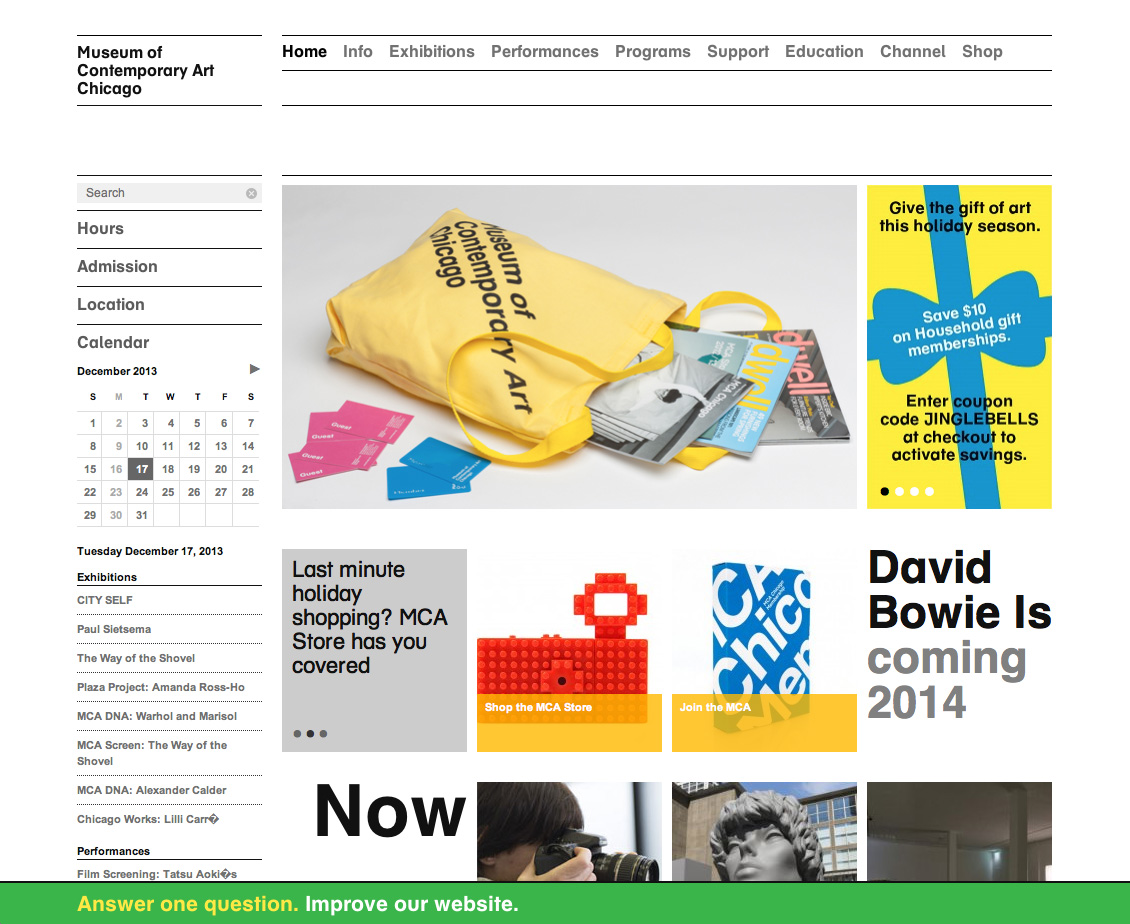
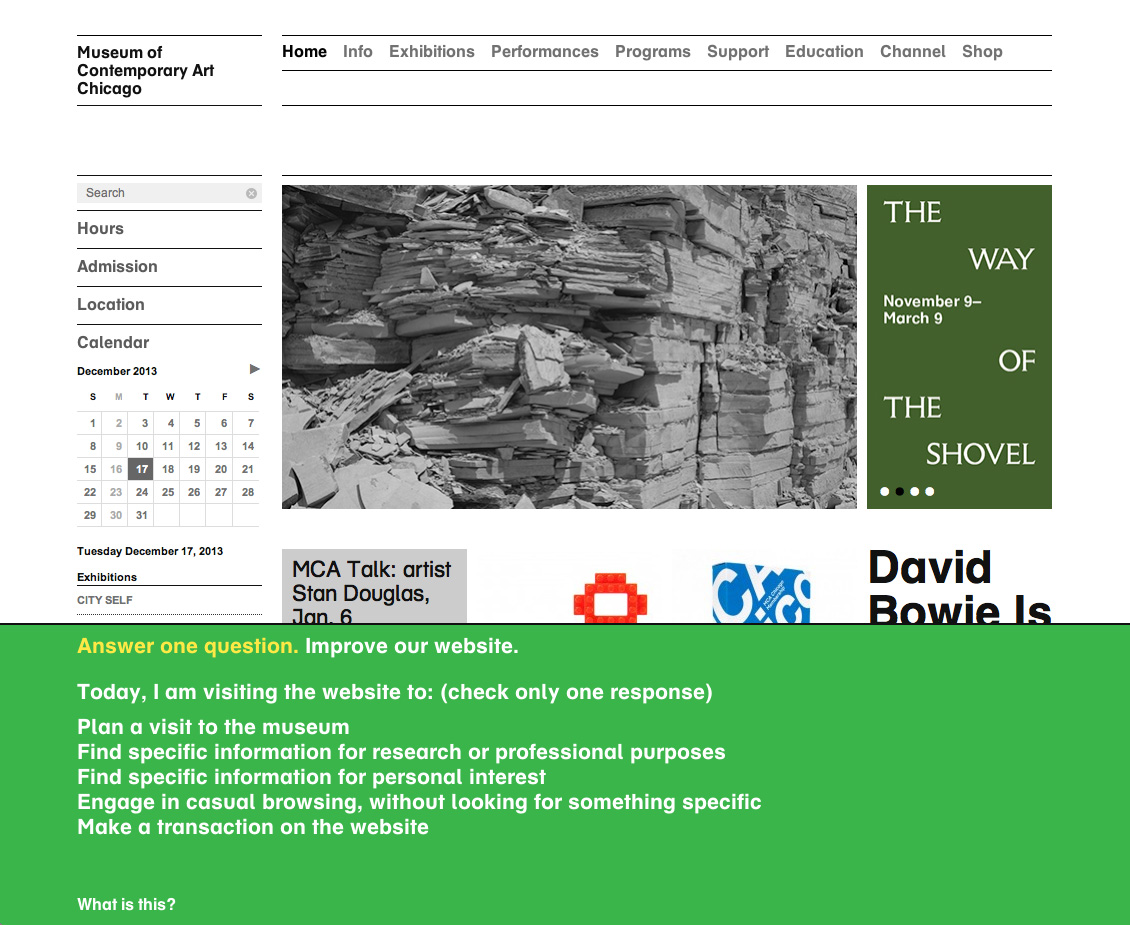
Working with the Museum of Contemporary Art Chicago, we wanted to increase our insight into how the site was being used. We knew that, in order to analyze current and inform future online offerings, we needed to be able to identify which kinds of users were accessing the site. Are there, in fact, different motivations for visitors to come to the MCA’s site? If so, how do those groups differ in their use of the site? To gain this information, we conducted a Visitor Motivation Survey.
We modeled our survey after a study by the Indianapolis Museum of Art. We placed a one-question survey on the homepage, asking visitors to the site to self-identify into one of five user groups based on why they were visiting the site that day. Assuming IMA’s methodology, the choices we presented were:
- Plan a visit to the museum
- Find specific information for research or professional purpose
- Find specific information for personal interest
- Engage in casual browsing, without looking for something specific
- Make a transaction on the website
The visitor’s choice was synced with Google Analytics, using a custom variable to tie it to the record of their browsing session. This allowed us to model activity across the site, segmented by motivational category.
Comparing Engagement Levels
By requiring participants to interact by answering the survey question, we could infer a minimal level of engagement with the site. We segmented this group of “engaged visitors” from those users who may have found themselves on the site erroneously. Comparing these samples allowed for a more informed analysis of site traffic overall.
The survey launched on Nov 4, 2013, and collected responses for 16 weeks, receiving 1,086 responses in total. A report based on the first eight weeks yielded revealing insights into the MCA’s online audiences.
Analysis of the survey data identified which motivation groups are most likely to return to the site, and the content these types of users are seeking to engage with. The Museum is now able to apply this information in a strategic content plan aimed at generating increased repeat visitation and overall site traffic.
Project Collaborators
Producer and Project Manager: Sarah Wambold
Designer and Developer: Marty Spellerberg
Shoutout/thanks to Gray Bowman for sharing code from the IMA’s implementation.
Website usability testing for the Clyfford Still Museum
This post is based on a report produced for Spellerberg Associates by Amanda Moon and Marian Oman. Their research was conducted at the School of Information at the University of Texas at Austin as part of a usability course taught by Randolph Bias.
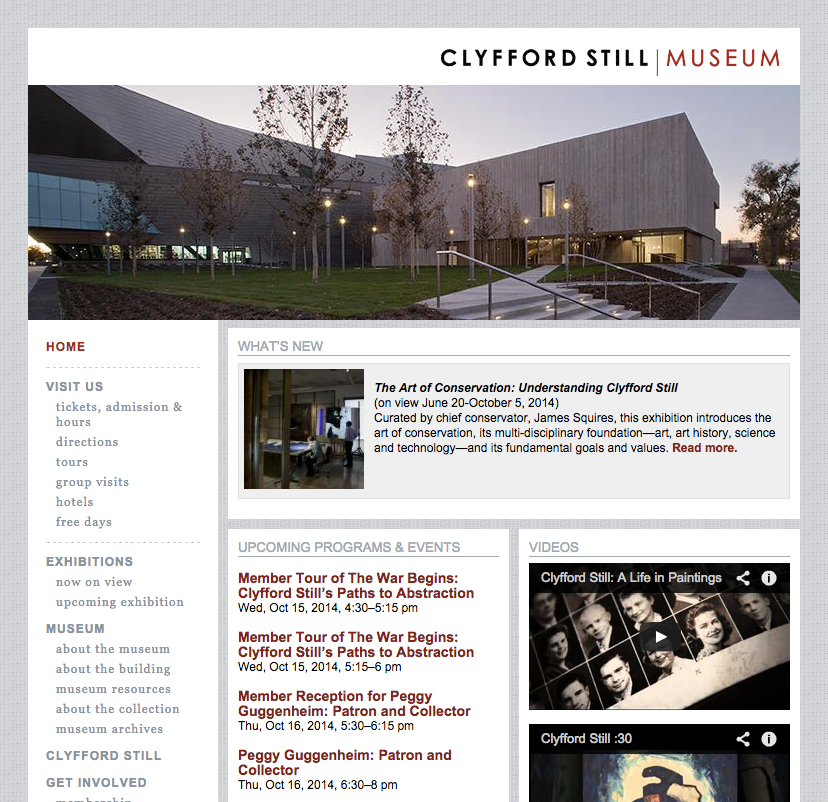
The Clyfford Still Museum in Denver, Colorado is a single-artist museum dedicated to the American master abstract expressionist painter. The Museum’s collection contains nearly 95 percent of the artist’s total output—more than 3,200 artworks—and houses the complete Still archives of sketchbooks, journals, and notebooks.
At the beginning of a website redesign project, we undertook a usability evaluation of the Museum’s website. Designing this evaluation to assist in identifying key areas of focus, our primary objectives were to:
- Better understand the mental models and expectations of website’s users;
- Identify the most salient usability shortcomings of the current site design;
- Offer recommendations for improving the overall user experience;
- Create a benchmark for any future usability testing.
We identified key use cases and goals by consulting with Museum stakeholders and conducting a heuristic site audit.
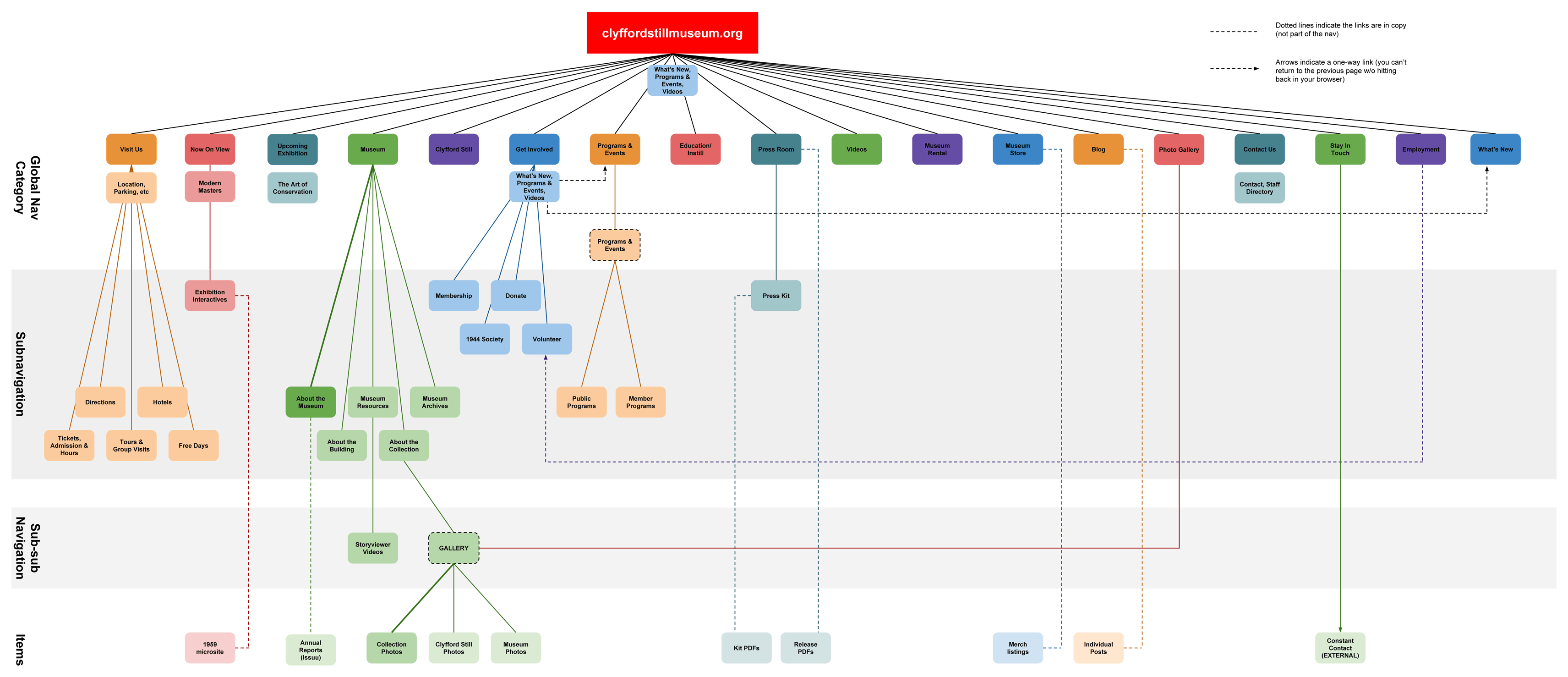
We then designed and conducted two evaluation activities:
- A card sort protocol generated insight into visitors’ mental models of site content and identified ways to improve the website’s information architecture and navigation;
- Three persona-based test scripts identified the most salient usability challenges presented to website visitors.
Twelve individuals participated in the evaluation, which was conducted at the University of Texas at Austin.
Card Sort
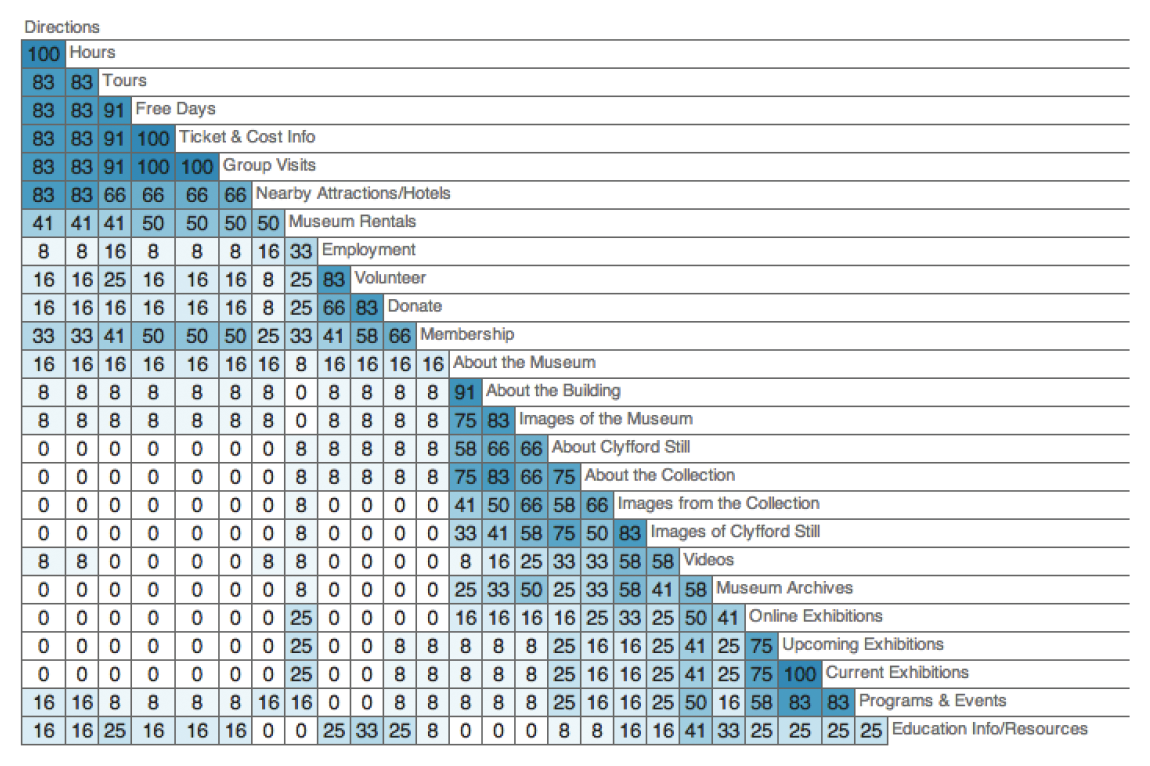
We narrowed 40 words from the existing website navigation down to 26 words that best represented the content. Each user then sorted these words into named categories using language of his or her own devising. They were encouraged to define no fewer than three and no more than five categories.
This activity was conducted using the the browser-based software program Optimal Sort, the results from which were used to generate a similarity matrix showing the percentage of participants who agree with each card pairing.
Task-based Test Session
User personas function as lenses through which to evaluate the site; each persona represents a distinct segment of the target audience and provides a framework for understanding that user segment’s typical goals and tasks.
We tested a broad swath of the site by testing three different user persona “paths,” which allowed us to test more tasks across all session types than would be reasonable to include in a single user’s test session. The three user personas we developed for this evaluation were:
The Art Enthusiast
You’re an art enthusiast living in Denver. Even though the Clyfford Still Museum has been open for a few years, you’ve never visited. You decide you’d like to check it out this Saturday. You will take your 7-year-old daughter and you will buy tickets online.
The Researcher
You’re a graduate student in Art History. You’re writing your thesis on some of Clyfford Still’s contemporaries, and you think some of their letters to Still may be housed in the Clyfford Still Museum’s archive.
The Educator
You’re a 5th grade teacher in Denver. You want to bring your class to visit the Clyfford Still Museum. Ideally, you’d like to schedule the field trip for a Tuesday morning next month.
Participants were assigned for their relative similarity to the user personas. For instance, the participants who completed “the educator” tasks were actually teachers.
We read each participant the persona-based scenario to which they had been assigned, then directed them to the website. They were asked to complete the tasks while “thinking aloud,” which provided insight into their thought processes as they moved through the website.
After the tasks were completed, the moderator asked several open-ended questions to identify any additional user needs or expectations that were not met by the website.
From Research to Redesign
This research revealed that improving the site’s navigation structure and consistency, creating more connections between pages, and increasing the image-to-text ratio throughout the site would be essential in the creation of a more user-friendly experience for Museum visitors.
This study provided was followed by additional phases of evaluation, including with Museum stakeholders, which tested the assumptions we’d made and the conclusions we’d arrived at. The entire process informed a website redesign, which launched in October 2014.
Websites for Artists Workshop 2014

Next month I’ll be teaching a “Websites for Artists” workshop at LIFT in Toronto. It’ll take place Monday, December 15 and Wednesday, December 17 2014, from 6 to 10 pm. From the programme:
This two-evening workshop provides an overview of how to establish a web presence from the preparation of content to the creation of a website for their artistic medium. Participants learn basic web theory and an understanding of how websites are constructed by planning and visualizing a layout for a multi-page site. An introduction to Hypertext markup language (HTML) and cascading style sheets (CSS) will be used as a basis of constructing web content. Dynamic content management systems such as WordPress and additional third-party web platforms (Youtube, Vimeo, Flickr, etc.) will be explored as alternative means of establishing a web presence and sharing work. This workshop will also cover getting your site published, registering your domain, hosting, and maintaining your website.
It’ll be a small group, so I’m looking forward to taking it in whatever direction the participants want. If you’re in Toronto, and looking to get started with your website or take it to the next level, I hope you’ll attend! Register in person at LIFT or by telephone: 416.588.6444.
LIFT (The Liaison of Independent Filmmakers of Toronto) is a member-driven non-profit organization that provides affordable access to equipment, education and space for those who want to make films, out of a passion for, and commitment to, the practice of filmmaking.
Notes from The Museum Interface
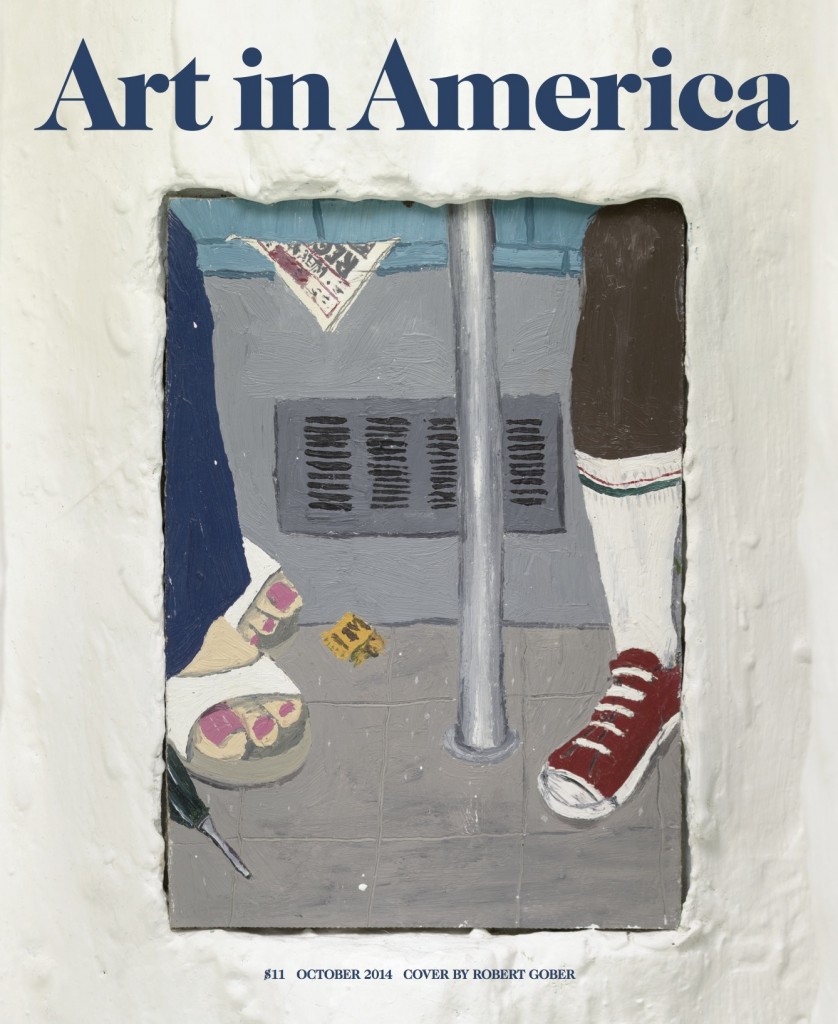
The October 2014 issue of Art In America was filled with pleasant surprises (Harsh Patel, Fluxus, Richard Tuttle), but the core was a series of articles on museums’ relationship to graphic design and the web. I was impressed by how these pieces were able to capture some of the issues and discussions currently being engaged with on the ground. My notes:
Hybrid Landscape
The experience of looking at art has become mediated by technology. This has been on the rise for a generation, but has intensified with the smartphone. Museums are continuing to apply new technologies toward the fulfillment of their mandates (collections, scholarship, access), finding both successes and pitfalls.
“It is no longer a question of whether art institutions should have a virtual presence.” Art institutions now exist virtually, as well as physically. Meaningful art experiences take place in both spaces, and in hybrids of the two. Designers facilitate these interactions, often via some combination of “publishing” and “database” models.
Museum as Publisher
Museums have long been publishers (catalogues, magazines, etc.). Older print practices continue to attract collectors and artists. Digital media represents a compliment, rather than a threat. Together they constitute the “expanded field” of publishing, encompassing digital works of art and literature, books, public conversations, exhibitions and performance.
This new publishing investigates connections between writing code and reading prose, between digital interfaces and printed pages, and between social media and public space.
Museum websites are well understood as a place where you go to plan a visit, but they’ve become much more. Often overseen by an editorial team, a museum’s website can be viewed as an online magazine with global reach. These sites are platforms for publishing art and history resources (scholarship, criticism, interviews) designed to be generate conversation across social media.
Museum as Database
The “database” model refers to presenting the museum’s collection online. This allows the visitor, via a limited set of interactions (sort by artwork creation date, click through an illustrated timeline, save to a list), to “curate” the museum’s collection to their own liking.
The designers of these interfaces strive for academic accuracy and a presentation (“performance”) of art history, but the collection doesn’t stay confined to these systems for long. As images are pulled out into social media and the wider web they enter other, uncontrolled narratives. By granting digital access to its collection, the museum open itself to new forms of public interpretation and challenges to its authority.
Encountering Artwork via Social Media
Social media has “enabling new phenomenologies around the way art is encountered, experienced and considered.” Some people willfully refrained from seeing a recent sculpture installation (Kara Walker’s sugar sphinx), because they felt they had already sufficiently experienced the piece through images seen in other’s social media feeds. But what is the effect of encountering an artwork for the first time via social media, rather than a museum?
Smartphone photography documents the installation, but when you experience an artwork via social media documentation, your experience is mediated by that of the original photographer. Each image is coming from an individual’s point of view, which may (literally and figuratively) be different than your own.
Familiarity born of repeated encounters with these second-hand images does not include the sensorial experience (such as, with Walker’s sphinx, the smell). There is also the danger that these encounters leach from the visitor the sense that an artwork could offer an experience that is unique, personal and transformative. When this happens a potentially powerful work of art is transformed into a commodified image.
New Art and Responses
While some museums have experimented with their own community platforms, hegemons have market and engagement share so dominant as to make these efforts irrelevant. Instead, museums are learning to harness the social and technical potential of these platforms through integration and interface design.
For their part, artists are using the Internet’s means of circulation (and “modes of concentration”) to extend into new dimensions, rather than replace, the physical object. For instance, when a choreographer considers not only the body on a stage but also its circulation online, “live” is simply one characteristic among many.
The most urgent art being created now goes further, to critically addressing this condition. Potentially referred to as “circulationism”, this art’s subject is the network, its circulation of information and the emergent modes of communication and perception this enables.
References
Art In America, Vol. 102, No. 9 (October 2014):
- Identity Crisis by William S. Smith (p. 108)
- Publish to Flourish by Gwen Allen, Triple Canopy, Paul Chan, Kay Rosen, Paul Legault, Miriam Katzeff (p. 124)
- The Museum Interface by Sarah Hromack, Rob Giampietro (p. 134)
Presentation at MW 2015: Agile Methodologies For Changing Project Scopes

I’ll be presenting at Museums and the Web in April. Sarah Wambold and I have put together a talk on Agile project management methodologies for museum website redevelopment projects we’re calling “Building the car while driving it.” We’ll be presenting on the first day of the conference, Thursday, April 09. From the programme:
Using real-world projects from the Museum of Contemporary Art Chicago and the Clyfford Still Museum as the basis for our discussion, the authors identify the principles of an Agile design approach tailored specifically to the needs of museums—with their many stakeholders, diverse audiences, and limited resources. We discuss roles, timelines, and the benefits achieved by employing Agile methodologies to respond to evolving project needs and priorities.
In preparation for the talk, we’ve put together a paper which has been published online.
Museums and the Web is “an annual conference featuring advanced research and exemplary applications of digital practice for cultural, natural and scientific heritage.” This year it’ll be held at The Palmer House in Chicago, April 8-11, 2015.
MuseumCamp 2015

MuesumCamp this year was amazing! Kudos to Nina Simon, Beck Trench and the team of organizers for crafting such a well-thought-out experience enabling 100+ of us to work through ideas of space and community.
I experienced Camp as a giant, time-and-space-constrained act of collaborative creation, the result of which will be a deck of “space making” exercise cards. But the deck is just a byproduct; the real accomplishment was the format of the event itself. It was an awe-inspiring feat of facilitation, scattering talks and workshops in between bursts of team collaboration, bonding opportunities and alone time.
The theme was “space”, in all the ways that can be interpreted. Emphasis was on making space for others, and claiming space for oneself and one’s community. The attendees came from such diverse backgrounds that I was able to have both conversations premised on commonalities (“I know, right?”) and difference (“I’ve never thought about that before”).
For me, there were two moments that really stood out. One was learning of the experience of a group of Filipino youth in SF, striving for life, liberty and punk rock in the face of societal alienation, peer violence and gentrification. It opened my mind to communities that might exist in my own neighborhood. The other was an impromptu opportunity to rehearse the seminal Fluxus happening Kicking a Guitar Around the Block, which drew a spontaneous audience murmuring, “oh they’re making art!”
After camp, I stayed on in Santa Cruz for a few days with MAH staff and nights with the community at the top of Mystery Spot Rd. Being among those beautiful people was an energizing experience, and I love them deeply.
Presentation at MCN 2015: WordPress as Museum Web CMS
I’ll presenting a session at MCN2015 in Minneapolis this November, in collaboration with Sarah Wambold. Titled WordPress as Museum Web CMS: Development and Content Strategy, the core audience for this discussion will be web teams considering implementing a CMS (or switching from another), are evaluating WordPress and want to know what to expect. From the description:
A look at three Museums using WordPress as their primary web CMS. Glance under the hood at implementations for the Museum of Contemporary Art Chicago, the Santa Cruz Museum of Art and History, and the Clyfford Still Museum.
Panelists will discuss how the each institution’s needs are manifested in code. What’s the same and what’s different; what’s off-the-shelf, and what’s custom? We’ll also consider WordPress’ impact on content strategy. What workflows does it enable; and what approaches fit with different institutional structures?
MCN (Museum Computer Network) attracts hundreds of attendees from around the cultural heritage sector to explore the latest advances in museum technology.
We’ll be presenting on Friday, November 6. Hope to see you there!